
Uniforms of the Russian Group of Marshal Zhang Zongchang's Army
All material and reconstructions are by A. Karevskiy unless noted otherwise.
1st Brigade of the 1st Army of the Mukden Forces, 109th Separate Brigade, 1923-1928
It is quite possible that Zhang Zongchang was the only Chinese person to be awarded the Order of St. George the Victorious. The award ceremony took place on 9 December 1926 after a decision of the general assembly of the St. George Knights. The marshal was awarded the lowest, but honourable, 4th degree of that order "for his personal courage and selfless bravery in battles with the Bolsheviks and their allies". The White Marshal was extremely moved and thanked the Russians for the honour bestowed upon him. The next day, in his palace, he awarded the Russian officers with the Order of the Fat Ear of Corn. In addition, he awarded all the soldiers and Cossacks with the lowest class of that order. (p.75)
In early 1927, Sun Chuanfang awarded Nechaev "For the protection of civilians from the Honghuzi bandits and for the humane treatment of the population by the Russians" with the highest award of the coalition : the Civil Order of the Fat Ear of Corn, 2nd Class. (p.79)
(7th Special Regiment, Chinese soldiers and Russian NCOs and officers) From the very first days of the new regiment's existence, the command had to deal with the fact that many officers wore shoulder-boards that were not those they were supposed to wear "according to their Chinese rank", but those they considered necessary. (p.79)
The communists describe Nechaev's men on leave as follows: "In Harbin, it is common to meet a typical Russian officer on the street, dressed in a Chinese military uniform, in most cases behaving like any old Russian officer, who has sunk to the lowest depths, escaping from the mud of the trenches to spend time in the rear. (p.163)
In the conditions of the civil war, when the enemies were the same Chinese who were fighting alongside you, with frequent clashes with the Honghuzi and local self-defence forces ... an identification system was extremely necessary in order not to be caught off guard by the enemy. Zhang Zongchang established a system of signals to identify his units using flags and lanterns, which changed colour on even and odd days. In addition, personnel were required to wear special insignia on their uniforms. However, many Russian officers were negligent in that regard. To combat that, which might cause unnecessary casualties, Major-General V. S. Semenov threatened to demote to the rank of private and remove the salary of any who refused to follow the established identification system.
In the summer of 1928, the distinctive mark worn by Zhang Zongchang's Russian and Chinese troops was a large square on an arm-band or as a breast badge. It had a black St. Andrew's Cross, dividing the square into four triangles of blue, red, white and yellow colours with Chinese characters. There were other insignia, for example, in the form of a rectangle with a thin black St. Andrew's Cross on the left edge and dividing up into small triangles on the sides of white, blue and red with a larger yellow pentagonal field to the right. (p.167)
Despite the fact that Russian mercenaries were in Chinese service and were supposed to wear the appropriate uniform, in reality there was a kind of mixed "Russian-Chinese" version. The uniforms were Chinese, but the caps were Russian. The cavalry later adopted Cossack-style trousers, "Far Eastern model", with yellow stripes. In winter, Chinese quilted trousers and jackets were issued, which did not always protect against the cold. The White Guards often lacked various items of military uniform, which were particularly prone to wear and tear during combat, ranging from belts to boots, and when the remnants of the Russian detachment marched in fifteen-degree frost in December 1928 in the Tsitsikara area to the railway for loading in Harbin, some soldiers did not even have hats. (p.189)
In November 1927, despite the lack of funding, food and accommodation for the Russians was free only at the front. At the same time, the Chinese became so insolent that they established a rule whereby uniforms were purchased at the expense of those who needed them. (p.192)
We now (30 August 1928) have a new uniform, previously designed for the escort, i.e. blue trousers with yellow stripes and a shirt with sewn-on pockets and yellow piping on the collar and boots, and new tunics. Makovkin was sent after them. He telegraphed that he could not get the uniforms, but would bring the boots in two weeks. (p.286, citing the diaries of Colonel A. A. Tikhomirov)
(5 December 1928) During the entire time, the soldiers received only poor-quality cotton uniforms and old bedding and blankets – 170 sets for the full complement. The men have no fur coats or warm hats. It is impossible to conduct classes outdoors, as the men only have summer caps and no gloves. It is good that boots and blouses were purchased in time with Zhang Zongchang's money. This was done through Liusilin, who bought them for more than $5 through Kochekov, when they could have been obtained here for a little over $2.(p.294)
We are still (8 December 1928) wearing shoulder-boards that do not belong to us. Valentin Stepanovich (Semenov) is sorry to part with his general's shoulder-boards. It would be too much to go to Harbin looking like this. Our entire detachment is completely disorganised. (p.295)
Balmassov, S. S. in "White Émigrés in Military Service in China", Moscow, 2007.
The uniform was Chinese. Grey coats with smooth copper buttons. On the shoulders were red shoulder-boards with narrow gold braid worn transversely, like those of cadets at Russian military schools. On the collars were buttonhole tabs with two red longitudinal stripes, the sign of military educational institutions. Junior cadets had a gold stripe and two stars on their shoulder-boards, while senior cadets had three stars. Sergeant-majors wore senior officer shoulder-boards without stars (silver with a gold stripe). The parade uniform consisted of a khaki shirt, matching trousers and boots. In winter, greatcoats were worn. The headgear was a cap with red piping and a five-coloured star as cockade. The cadet's waist was tightly bound with a leather belt. Cartridges were carried in Russian cartridge pouches and cartridge belts. On marches, cadets wore a guard-style knapsack. The Chinese uniform, so clumsily and untidily worn by the Chinese, took on a completely different look on Russian cadets. Even among Russian soldiers from other units, the cadets stood out for their fitness, bearing, and ability to maintain the special military panache that was always characteristic to them.
Uvarov, B. in "The Shandong Officer Training Detachment (1925-1928) // White Emigration in China and Mongolia", Moscow, 2005, pp.143-144.
Reconstructions
Photographs published in the following sources were used in the reconstruction of uniforms:
Balmassov, S. S. "White Émigrés in Military Service in China", Moscow, 2007.
"White Émigrés in China and Mongolia", Moscow, 2005.
Yakovkin, E. V. "Russian soldiers of the Kwantung Army", Moscow, 2014.
Okorokov, A. V. "In the battles for the Celestial Empire: Russian traces in China", Moscow, 2013.
Okorokov, A. V. "Russian volunteers", Moscow, 2007.
Jowett, P. S. "Chinese Warlord Armies 1911-30 // Osprey Men-at-Arms", Oxford, 2010.
Jowett, P. S. "Chinese Civil War Armies 1911-49 // Osprey Men-at-Arms", Oxford, 1997.
Photographs freely available on the Internet.
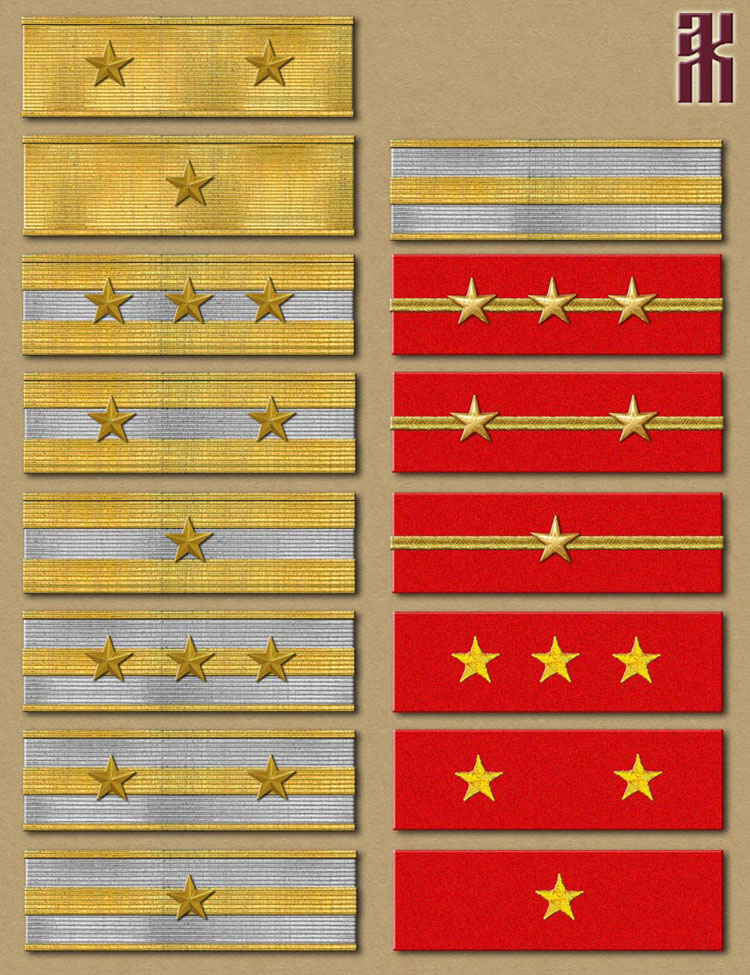
Insignia of the Republican Army, including the Mukden troops
(the shoulder-boards were the same for all branches of the armed forces).
Left column (top to bottom): Lieutenant-General (Shung-Chiang); Major-General (Shao-Chiang); Colonel (Shang-Xiao); Lieutenant-Colonel (Shung-Xiao); Major (Shao-Xiao); Captain (Shang-Wei); 1st-Lieutenant (Shung-Wei); 2nd lieutenant (Shao-Wei)
Right column (top to bottom): Officer Candidate/Ensign (Chung-Wei); Senior Sergeant (Shang-Shih); Sergeant (Shung-Shih); Corporal (Shao-Shih); Senior Private (Shang-Teng Ping); Private 1st Class (Yu-Teng Ping); Private 2nd Class (Yer-Teng Ping)
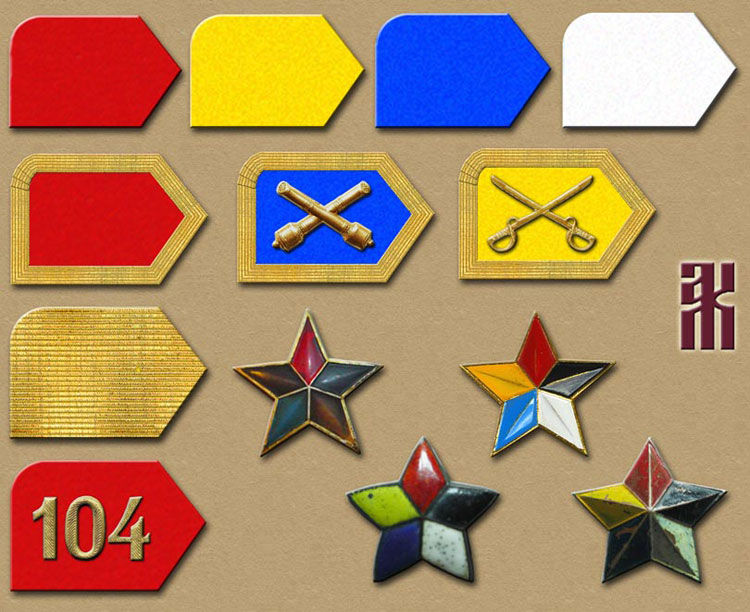
Top row: collar tabs of privates and NCOs (red for infantry, yellow for cavalry, blue for artillery and armoured trains, white for engineering units).
Second row: officer's collar tabs;
Bottom rows: general's collar tab, ordinary infantry collar tab and cockades.
Some photographs show crossed guns in the artillery and crossed sabres in the cavalry on officer lapels. It is unknown if these were from the time of the Russian Civil War or were locally created. While general's lapels were to be made of gold braid, known photographs of generals in the Russian group do not show any. At one time the Russian brigade included the 104th and 105th Infantry Regiments, and while the corresponding numbers should have been located on the shoulder-boards, but this cannot be seen in the photographs.
The five colours on the cockade of the Republican Army symbolised the major ethnic groups of China.
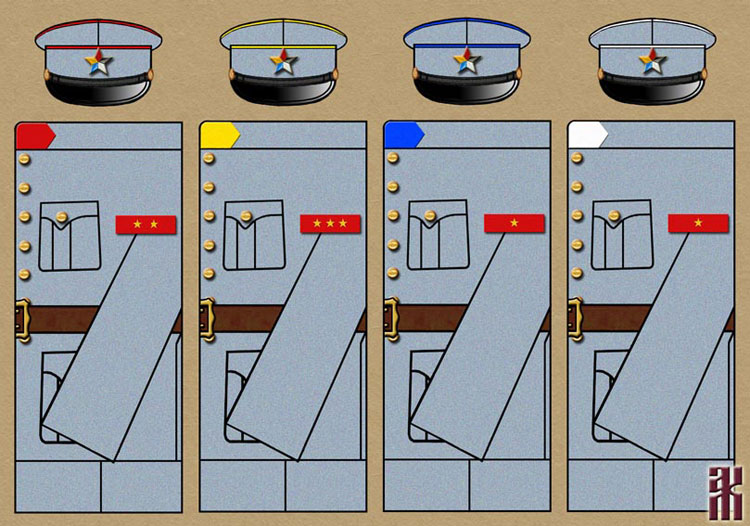
"Model" uniforms for other ranks: infantry, cavalry, artillery and engineer.
In practice the uniforms varied greatly.
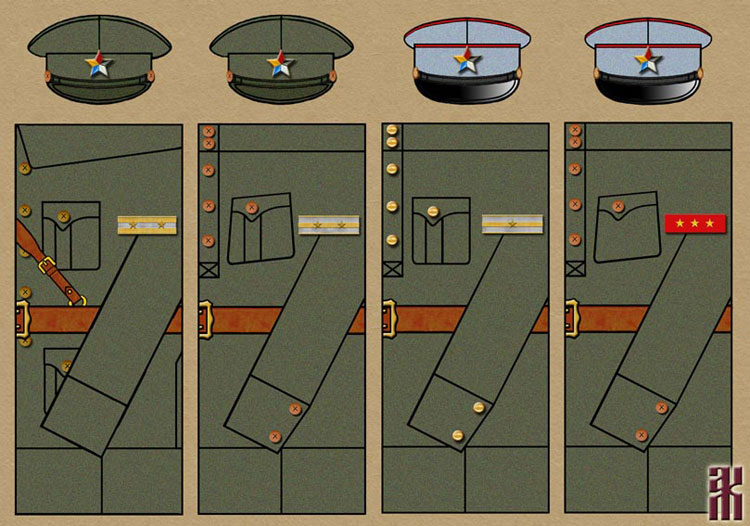
Officers' uniforms from the early days of the Russian Group
These were entirely Russian, preserved from the Civil War, but with Chinese buttons and insignia sewn on. They were sometimes complemented by Chinese caps.
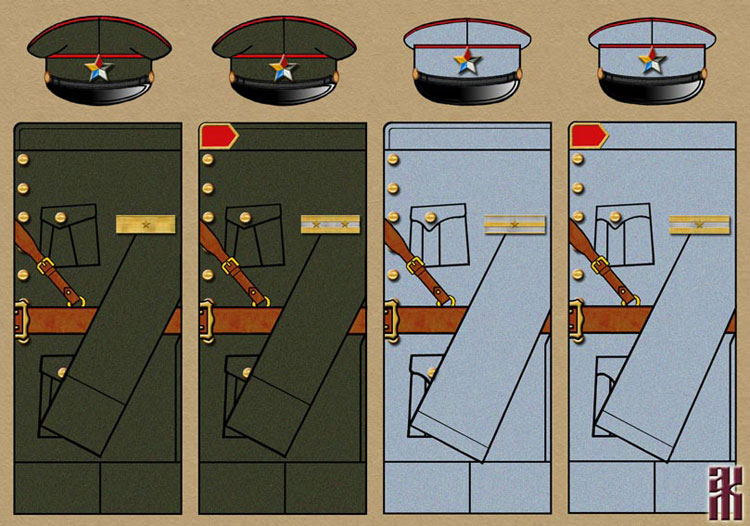
Examples of infantry officer uniforms of the Russian Group
Figure 1 is based on a photograph of Major-General G. K. Sidamonidze of the Chinese service. The khaki uniforms were made of heavy cloth and were considered winter uniforms, while the light grey uniforms were made of light cotton fabric for summer.
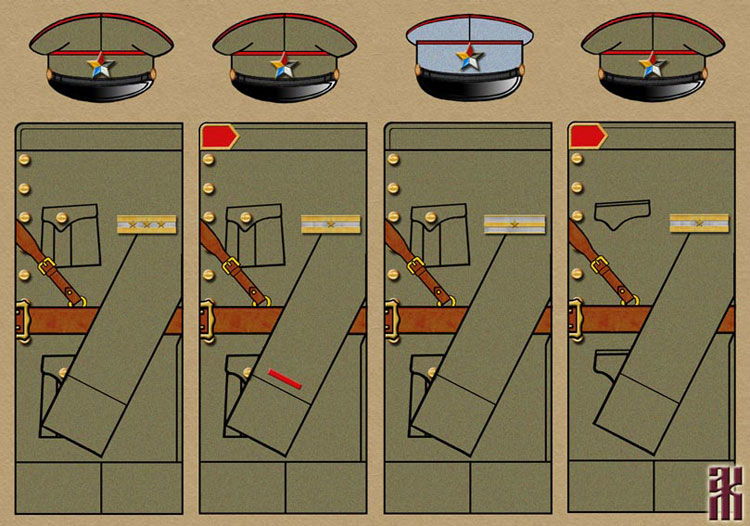
Examples of infantry officer uniforms of the Russian Group
The light olive-coloured uniform was intended as a dress uniform, but due to acute supply shortages, it was often used for everyday wear. An interesting detail is that coloured button tabs on the stand-up collar were found on the uniforms of at most half of the military personnel.
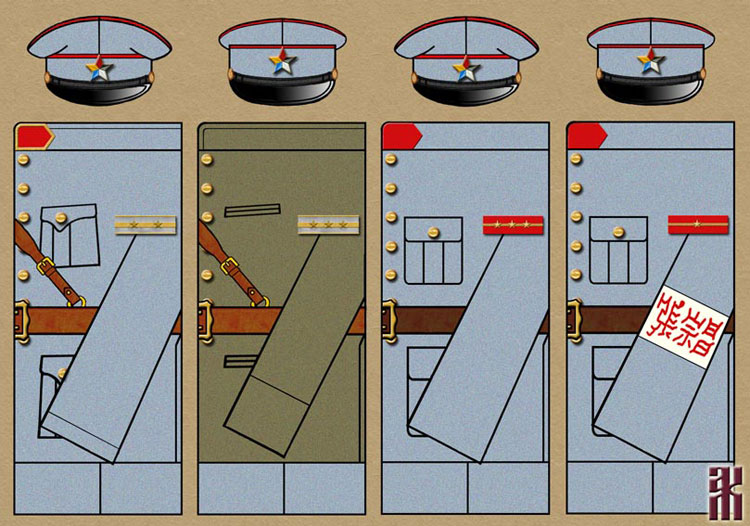
Examples of infantry officer uniforms of the Russian Group
Another feature caused by the shortage of uniforms was the wearing of mixed uniform variants.
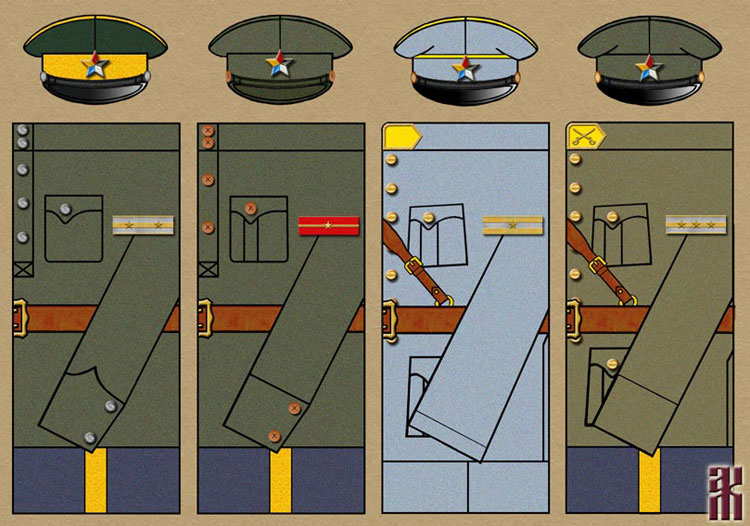
Examples of cavalry officer uniforms of the Russian Group
Figures 1 and 2 show examples of Russian uniforms from the Civil War era, in this case Cossack, worn with Chinese insignia and cockades. Breeches with yellow stripes were often used in the Russian group's cavalry brigade and were later "legalised" by the army commander, Marshal Zhang Zongchang.
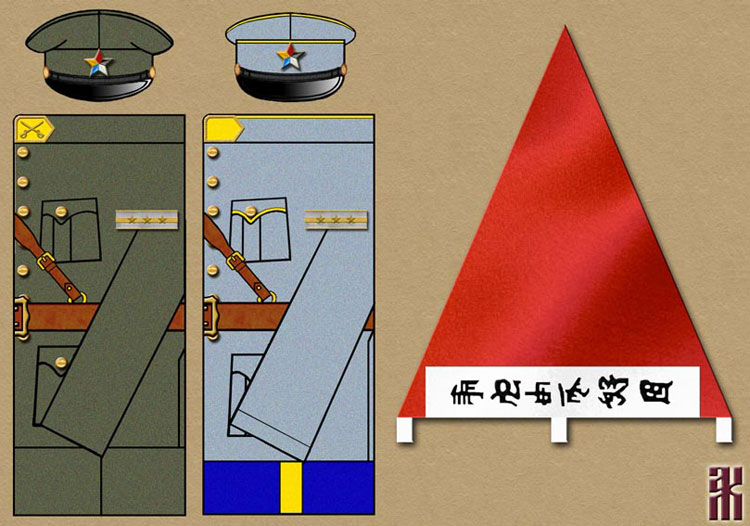
Examples of cavalry officer uniforms of the Russian Group
Figure 2 is the uniform of the personal escort of Marshal Zhang Zongchang, designed and approved by him. On the right is a lance pennon.
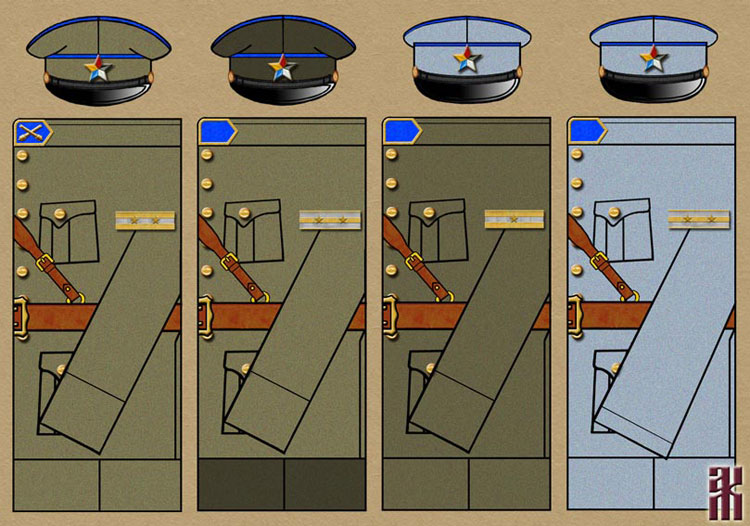
Examples of artillery and armoured train officer uniforms of the Russian Group
The uniforms were made and sewn by the group's own quartermaster corps, so the colour of individual items could vary considerably.
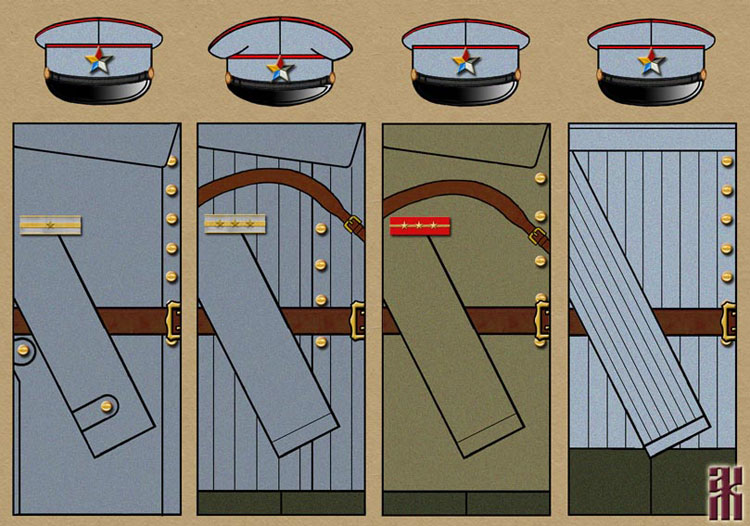
Winter uniforms used by the Russian group:
1 – overcoat; 2 – quilted jacket; 3 – raincoat; 4 – short quilted jacket
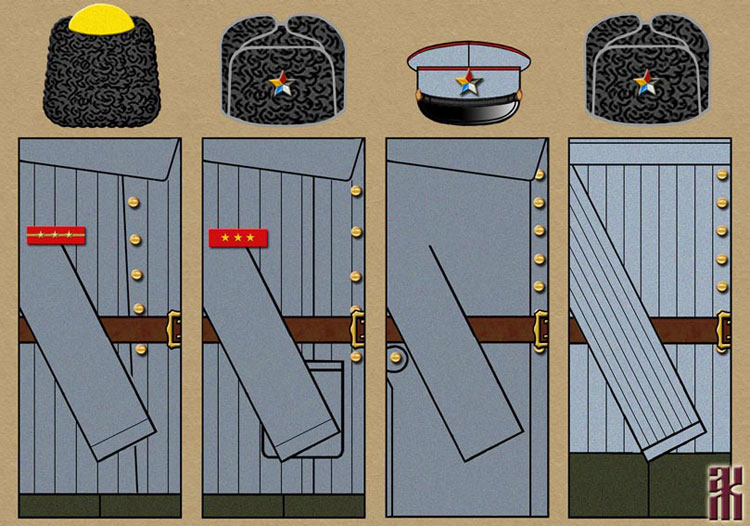
Winter uniforms used by the Russian group
Figure 1 has a quilted jacket and Cossack papakha, a combination used in the Cavalry Brigade. Figures 2 and 4 show a fur ushanka, used mainly in artillery and machine gun units.
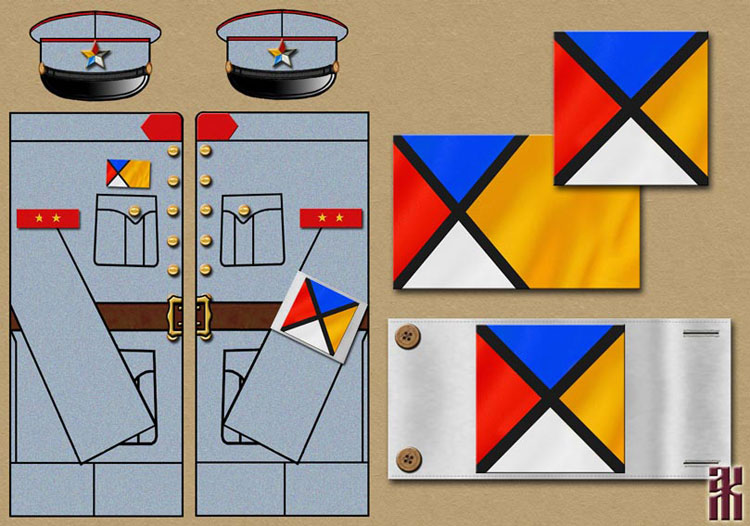
Identification marks and examples of their use on uniforms
The arm-bands and breast patches were introduced due to the opponents (other warlords) wearing identical uniforms.
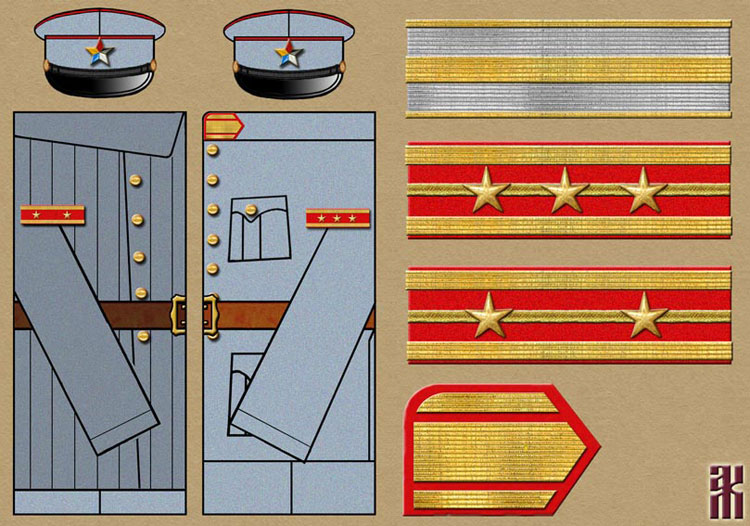
1 and 2 – Uniforms of cadets of the Shandong Officer Training Detachment;
3 to 5 – Shoulder markings for sergeant, senior cadet, and junior cadet;
6 – cadet collar tab
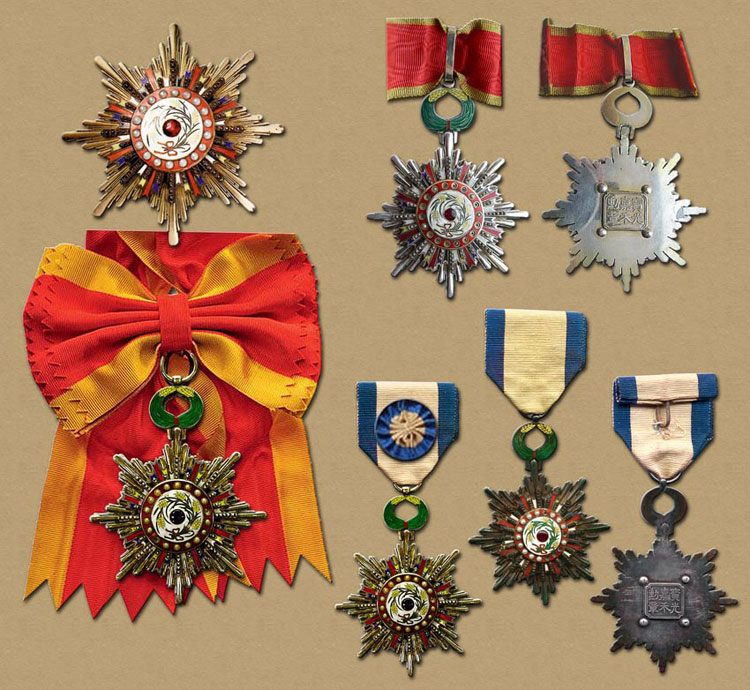
Orders of the Fat Ear of Corn: 1 and 4 – 2nd Class; 2 and 3 – 3rd Class;
5 &ndash 4th class (with a rosette on the ribbon); 6 and 7 – 5th class
Established on 29 July 1912 to reward civil service, the order was used in the various coalitions of Chinese warlords – including the Russian brigade in Marshal Zhang Zongchang's army. Only brigade commander General K. V. Nechaev was awarded the 2nd Class. The 5th Class was the most common awarded to the brigade's officers.
Home — State Symbols — Flags — Uniforms — Badges & Medals — Money — Other
Pygmy Wars Notes
The original for this page is at kolchakiya.ru/uniformology/109_Chinese_brigade.htm.
Discussion on the translation choices I have made can be found here.