
Flags of Military Training Institutions in the Army of the Supreme Ruler
Training Instructor School on Russky Island (Knox School)
Presented by General Knox on behalf of the British Army and consecrated on 1 January 1919 in the school's military church. It was a combination of the Russian national flag and the St. Andrew's flag with the image of St. George the Victorious and the motto "For Faith and Salvation of the Fatherland".
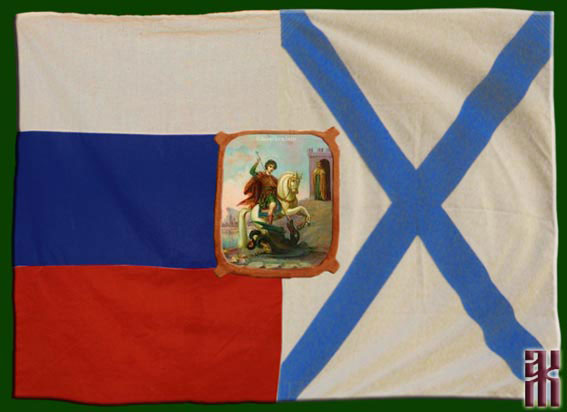
Reconstruction by A. A. Karevskiy of the front of the flag of the Training Instructor School on Russky Island, based on a photograph published on the website voenforum.ru
This school ceased to exist on 31 January 1920, following the coup in Vladivostok. In early February 1920 the new government promoted the cadets to officers. A group of graduates stole the banner and left for Grodekovo, where they formed a significant cadre in the Independent Ussuri Cossack Divizion. The banner then became the flag of that divizion before becoming that of the 2nd Plastun Rifle Regiment of the Armed Forces of the Provisional Amur Government.
Sakharov, K. V. in "White Siberia: Admiral Kolchak's Eastern Front", Moscow, 2004, pp. 112-113.
Hartling, K. in "Guarding the Motherland: The Great Siberian Ice Campaign", Moscow, 2004, p. 589.
Order of the Military Department No. 1, Omsk, 18 January 1919.
The Supreme Ruler and Supreme Commander-in-Chief ordered the following order to be issued on 18 January of this year:
In early December of last year, a training school for officers and NCOs of the Russian army was established in Vladivostok, on Russky Island.
The school was organised with extensive support from the British mission and the active participation of British instructors.
From the very first days of its existence, the school's work has yielded excellent results and leaves a strong, healthy and wonderful impression in all respects. General Knox of the British service took the most active part in the creation and provision of the school with everything necessary, and his efforts and attention in this direction are enormous and invaluable.
On 24 December last year, General Knox, head of the British military mission, presented the school with a special banner as a gift from the British Army as a sign of sincere friendship and a desire to help revive the glorious Russian Army. It was in the form of our Petrine flag with the image of St. George the Victorious on the front and the school's motto, "For Faith and the Salvation of the Fatherland", on the back.
This profound attention, sincerity, grateful efforts and ardent desire to help and support us in our hour of need fill our Russian hearts with brotherly joy and great gratitude to the victorious British Army and its most worthy representatives.
In General Knox, whose name is well known in Russia, we Russians see a true friend of Russia and the Russian Army, who has rendered us enormous services many times over with his efforts, knowledge and authority.
The resurgent Russia and the Russian Army will not forget these efforts and noble services of their true friends in the difficult times the country is going through.
On behalf of the renewed Russian Army and on my own behalf, I offer General Knox my warmest gratitude and heartfelt Russian thanks, and ask that these be conveyed to the British Army.
The banner presented is to be honoured and preserved as a military regalia, and it is to be accorded the honours due to it in accordance with existing laws.
Minister of War, Major General Stepanov
siberia.forum24.ru/?1-4-0-00000027-000-0-1-1361461097
Naval School in Vladivostok
The school had a banner under which it marched to suppress General R. Gaida's coup.
Hartling, K. in "Guarding the Motherland: The Great Siberian Ice Campaign", Moscow, 2004, p. 606.
Home — State Symbols — Flags — Uniforms — Badges & Medals — Money — Other
Pygmy Wars Notes
The original of this page is at kolchakiya.ru/vexillology/teaching_units_flags.htm.