
Flags of Anti-Bolshevik armed groups in the 1920s and 1930s
(Volga region, Urals, Siberia)
The Rebel People's Army of Ataman Bychkov
The Bukhtarma Uprising (July-August 1920)
A congress of representatives of the rebellious settlements, villages and hamlets gathered in Bolshe-Narymskaya. It was decided to carry out mobilisation, bring all the units together into regiments and form them into the Rebel People's Army. The chief of staff, who was also the commander-in-chief, was A.S. Bychkov. ... In total the rebels managed to form up to five regiments (3,000-3,500 men), probably mixed Cossack-peasant units. Some units had red flags.
Shuldyakov, V. A. in "The Demise of the Siberian Cossack Army, 1920-1922", Moscow, 2004, p.145.
The Peasant and Cossack People's Army of Captain Shishkin
Semipalatinsk Uprising (June-August 1920)
V'yuny-Kolyvan' Rebellion
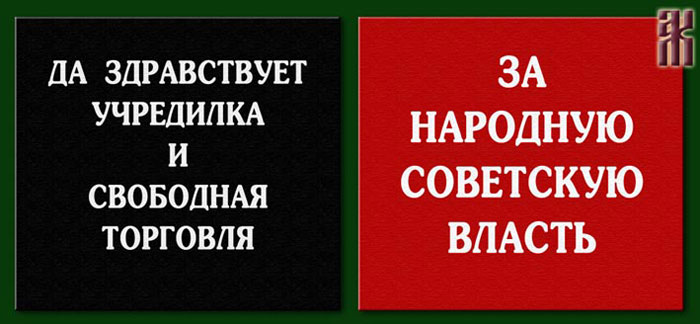
Banners of the units of the Peasant and Cossack People's Army of Esau Shishkin
The impetus for such a large-scale uprising was the conscription of the young men born in 1901 into the Red Army, which began on 25 June. At first the rebels formed a single regiment from peasants in the Alekseevka, Marzagulka, and Pavlovka parishes. At the end of June that regiment was divided into three: the 1st, 2nd and 3rd Peasant Regiments. The headquarters of the People's Insurgent Army was established in Alekseevka. The commander-in-chief, who was also the chief of staff of the army, was Berezovskiy, a peasant from the Sosnovka volost. The initial slogans: "Long live freedom, equality, brotherhood and love", "Long live the soviets, down with the Communists, no to capital", and in some places "All power to the Constituent Assembly" show that the rebels' programme was rather vague. ...
The rebel detachments advanced in three main directions: the 3rd Peasant Regiment went to the north (towards the villages of Kaip and Klyuchi, in the direction of Slavgorod), the 2nd Regiment to the north-east (towards the village of Volchikha in the Pokrovskaya parishes of the Slavgorod district), and the 1st Regiment to the south (towards the Irtysh and Semipalatinsk). By 10 July the territory of the uprising had expanded significantly, and Berezovskiy's rebel army had 8-9 regiments (a total of about 10,000 men). Judging by the numbering of the units, the army headquarters planned to deploy 12 regiments. The largest was the 5th Peasant Regiment, formed from the inhabitants of the villages of Volchikha, Ust'-Volchikha and Ust'-Kormikha (up to 4,000 men, but only 100 rifles). ... The entire command structure of the rebel army was elected. They did not wear shoulder-boards. They addressed each other as "comrade." Some detachments had red or black banners. ...
The uprising developed particularly successfully in the direction of least resistance – towards Slavgorod. In that area the rebels, initially putting forward a slogan that was by no means anarchist, but rather SR-like, "Long live the Constituent Assembly and free trade", marching for some reason under a black banner. The population, local communists, and then the punitive forces began to call the rebels the "black banner" detachments or simply "blacks". Units of the Red Army, pursuing the peasants, brought this term to the Irtysh. By that time the rebels had only red banners (and a new slogan: "For people's Soviet power!"). Nevertheless, the enemy continued to call them "blacks", as the term itself was very clear to the regular troops: unlike the Red Army soldiers, who were dressed in khaki uniforms, the rebels wore their civilian clothes, and on the battlefield their chains looked black. In addition, the term appealed to the political workers of the Red Army, who gave it the most negative meaning possible ("black gangs", etc.).
Shuldyakov, V. A. in "The Demise of the Siberian Cossack Army, 1920-1922", Moscow, 2004, pp.163-164.
From a report by A.I. Bolshakov, member of the Semipalatinsk Provincial Executive Committee, to the Semipalatinsk Provincial Executive Committee. 31 August 1920 in Semipalatinsk,
It is clear that the population of the region that took part in the uprising, mainly Cossacks, was provoked by dark, criminal elements from the world of "dark people" who longed for the free hiring of workers, free trade and other "delights" of the previous kulak-bourgeois system. This is evidenced by the fact that the vast majority of the rebels marched with red flags and slogans such as "Down with the communists, long live Soviet power, long live free trade!"
Yakovlev, A. N. (ed) and Shishkin, V. I. in "Siberian Vendée: Documents, Volume 1 (1919-1920)", Moscow, 2000, p.395, citing GASO. F.72. 0p.1 D.27 L.58. Typescript original.
The Irtysh River between the villages of Yamyshevskaya and Chernaya, 28 July 1920.
The Reds seized the office and property of the rebel "army" headquarters on the steamer Vityaz, as well as its banner. The flag of the Peasant and Cossack Army was a red cloth with three pikes on it, and the words "Down with the commune, down with all violence. Long live the power of the soviets of all workers." The cloth was attached to a pole with a spear tip.
Shuldyakov, V. A. in "The Demise of the Siberian Cossack Army, 1920-1922", Moscow, 2004, p.181.
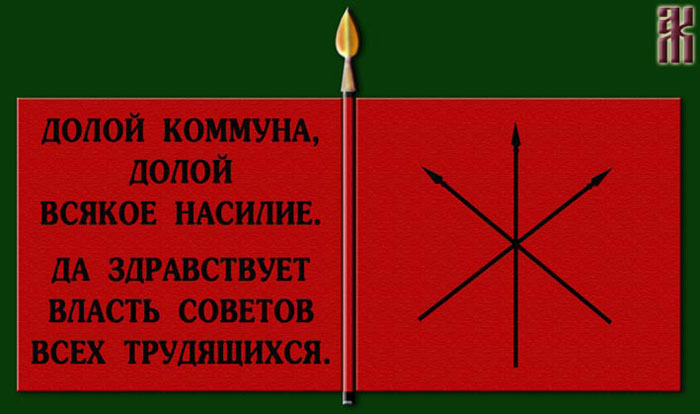
Reconstruction of the banner of the Peasant and Cossack People's Army
Direct telephone negotiations between Omsk Provincial Commissar B. I. Monastyrskiy and the Soviet leadership of Slavgorod County. 3 July 1920.
... The Mikhailov, Klyuchevka, Kaip and Pokrovka parishes are occupied by "Black Banner" gangs. The first attack and occupation took place on 3 July in the villages of Marzagul, Rakit and Borovoy Forpost: in the latter the bandits fought local cells that had joined forces with the militia. The result was that the cells were forced to retreat. In some villages the bandits captured all the cells and shot them. Five hundred head of cattle, allocated according to the quota, were seized at the collection point in Kaip. The cells and the militia are retreating under fire towards Slavgorod. The gangs are united under the commander of the 1st Peasant Dombrovskiy Regiment. The population of the occupied villages welcomes these gangs as liberators. The gangs mobilise peasants up to 45 years old. They march under a black banner, but under the slogan "Long live the Constituent Assembly and free trade."
Yakovlev, A. N. (ed) and Shishkin, V. I. in "Siberian Vendée: Documents, Volume 1 (1919-1920)", Moscow, 2000, p.163 citing RGVA F.16 Op.3 D.44 L.83.
Uprising in Chelyabinsk County (1920)
Summary of the Chelyabinsk Provincial Cheka for the Upper Ural Region, 1920:
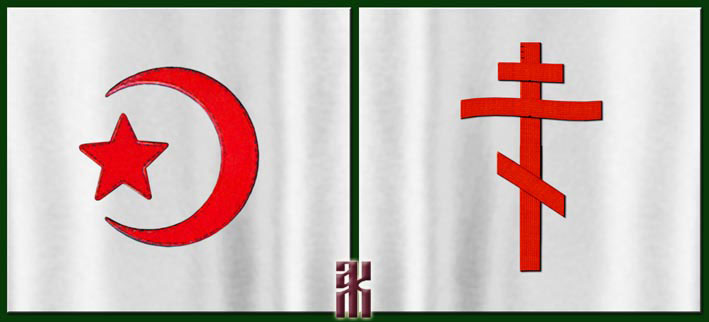
Flag of the Lukonin detachment
25/X. A gang of 150 people occupied Karagayly, 30 kilometres from V-Uralsk, where 54 Communists surrendered, 18 of whom were arrested, while the rest joined the bandit detachment. We captured the post office during the battle. A detachment sent from Uysk drove the bandits out of Karagayly, recapturing the prisoners, 94 carts of wheat, and 10 horses. The bandit detachment has a white flag with a crescent, star, and cross. The bandits wear green badges. The detachment is commanded by Lukonin, a teacher from the village of Fominskoe, and his assistant and adjutant Luzin.
raritet-chel.ucoz.ru/load/dokumenty/svodka_cheljabinskoj_gubchk_1920_g/2-1-0-54
(Note by N. Zayats: These "bandits" were Bashkirs fighting for the return of Validov. In their appeals, they refer to themselves as "Red Army Bashkirs", demanding an end to the atrocities of the Communists, and concluding with the words "Long live Lenin! Long live Validov! Headquarters of the Red Army of Bashkiria").
The Blue Army: Uprising in Chelyabinsk and Troitsk Districts (July-August 1920)
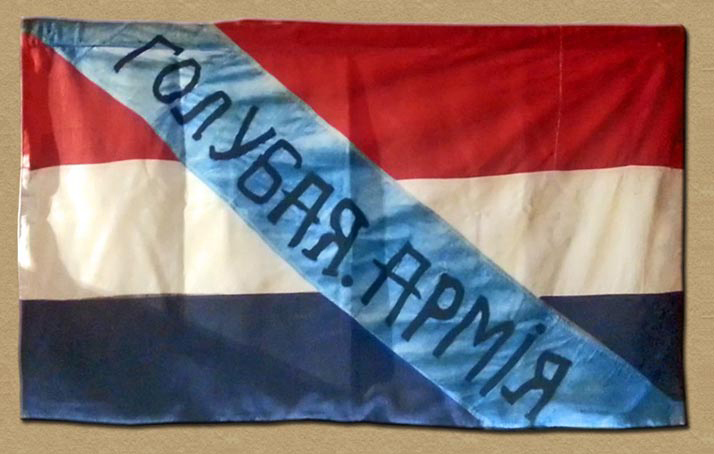
Banner of the "Blue National Army of the All-Russian Constituent Assembly" (from Rzhavin)
Sewn at the end of June 1920 by Anna Yakovlevna Kochneva, daughter-in-law of N.E. Kochnev, on whose farmstead the headquarters of the Blue Army was located and a congress of representatives of rebels from the Troitsk and Chelyabinsk districts was held. In August 1920, it was captured by units of the Chelyabinsk Military District during an attack on the rebels' headquarters. It is currently kept in the collections of the Central Museum of the Armed Forces (Moscow).
emanzelinkalib.ucoz.ru/news/pechalnaja_raduga_grazhdanskoj_vojny/2012-12-01-1
Rzhavin A. "The Blue Army" at rzhavin77.livejournal.com/47390.html
They justified their colour by saying that their power did not belong to the party, but was "the instrument of the majority of the Russian people". The Blue Army saw its creed in non-partisanship and relied on this in contrast to the still fresh memory of party building and party squabbles that led Russia to coups and civil war.
chelyabinsk.bezformata.ru/listnews/chelyabinskaya-oblast-opalennaya-v-vojnah/644725
From the "Manifesto of the Blue Army", found in the village of Klyuchevskoe, Emanhelinskaya Stanitsa.
The Blue Army is fighting for the immediate convening of the Constituent Assembly, defending its national interests, and therefore is officially named: "The Blue National Army of the All-Russian Constituent Assembly".
The Blue Army, raising its blue banner high, puts forward the following slogan: "Everything for the people and everything through the people...".
Rzhavin A. in "The Blue Army" at rzhavin77.livejournal.com/47390.html.
New soldiers received arm-bands with the letters "G. A.". A blue banner was sewn.
chel-portal.ru/?site=encyclopedia&t=golubaya-armiya&id=5826
The "Rogovshchina" (1920)
On 1 May 1920, in Zhulanikha, which was the "capital" of the partisans of the Prichernka region, about a thousand former partisans from the surrounding villages and hamlets gathered to rebury their comrades who had been killed by the White Guards. At a rally organised for this purpose, Rogov, Novoselov and their supporters spoke out against the communists and in favour of establishing anarchy. The podium was decorated with black flags bearing the inscription "Long live anarchy – the mother of order!" As a result, the anti-communist sentiments of the partisans intensified sharply.
TsKhAFAK. F.p.1061. Op.1 D.520 L.1; D.514 L.18. Quoted from: Yakovlev, A. N. (ed) and Shishkin, V. I. in "Siberian Vendée: Documents, Volume 1 (1919-1920)", Moscow, 2000, p.74.
Telegram from the chairman of the Altai Provincial Cheka, I. I. Karklin, to the Cheka and the Cheka's plenipotentiary representative in Siberia, I. P. Pavlunovskiy. Barnaul. No earlier than 5 May 1920.
The uprising is developing. Police intelligence has been disarmed and the rebels are approaching Chumysh. The commissariat of the 3rd district has been liquidated. The uprising is proceeding under the banner "Down with the government".
Pre-Altai Provincial Cheka, Karklin
Yakovlev, A. N. (ed) and Shishkin, V. I. in "Siberian Vendée: Documents, Volume 1 (1919-1920)", Moscow, 2000, p.74 citing RGVA F.42 Op.1 D.1896 L.18.
Report by the military and political leaders of the Altai Provincial Cheka detachment to the chairman of the Provincial Cheka. No earlier than 7 May 1920
According to reliable information, there are no Rogovtsy detachments in the Togul area or in the village of Togul itself, but good communication has been established through local residents. The residents are frightened by the murders committed by the gangs. Soviet workers are afraid to resume the work suspended by the Rogovtsy, and Novoselov's headquarters is located in Ozerno-Titovskaya. Black banners have been placed near the headquarters. Novoselov has a detachment of 100-150 men at his disposal, armed with revolvers, rifles and shotguns. Rogov is also going there (information provided by Novoselov's scout). According to information provided by the chairman of Staro-Togulsk [parish], Rogov has a detachment of 180 men armed with rifles.
Yakovlev, A. N. (ed) and Shishkin, V. I. in "Siberian Vendée: Documents, Volume 1 (1919-1920)", Moscow, 2000, p.79 citing RGVA F.17590 Op.1 D.14 L.15.
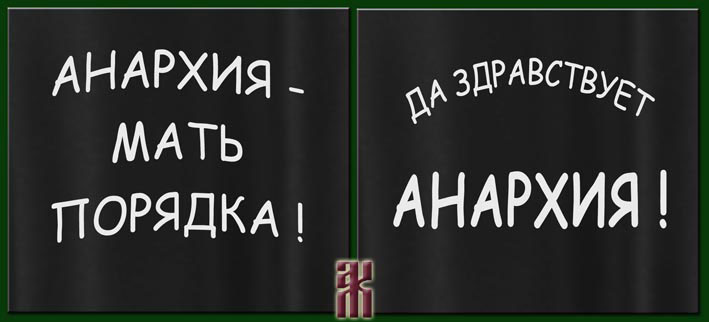
Reconstructions of the flags of Rogov and Novoselov's detachments
Report from Savin, assistant commander of the 2nd platoon, to the commander of the 2nd company of the 115th Independent Rifle Battalion of the Siberian Railway Defence Forces. 14 May 1920.
I report that on this date I returned from intelligence reconnaissance and ascertained the following: having travelled to Bazhina, 85 km from Cherepanovo Station, I learned from the citizens of the village that Rogov's troops are riding around in the area Zalesovo and Sorokino with black flags bearing the inscription "Long live anarchy". The main organisers of the anarchy are Rogov, Novoselov, Leonov, and Vozipkin.
PomKomVzvod-2 [Assistant Commander Platoon 2] Savin
RGVA F.982 Op.3 D.36 L.49. Autograph. Quoted from: Yakovlev, A. N. (ed) and Shishkin, V. I. in "Siberian Vendée: Documents, Volume 1 (1919-1920)", Moscow, 2000, p.94.
Report by the Chairman of the Talitsk Parish Executive Committee of Soviets of Lomonosov to the Barnaul District Revolutionary Committee. Cheremushkinskoe. 14 May 1920
I, the chairman of the Talitsk Volost Executive Committee of the Altai Province, Barnaul District, on this day, continuing my work in the premises of the Parish Executive Committee, at exactly 11 o'clock I saw a gang of anarchists with a black flag bearing the inscription "Anarchy is the mother of order, long live equality and brotherhood!" rush in from Shatunovka parish, coming from nowhere. The aforementioned gang of 54 people [was] in tattered uniforms, some of them armed with rifles and old-style muskets, and some with hunting shotguns, sabres and revolvers with torn covers, some on saddled horses, and some without saddles.
Chairman of the Volga Executive Committee Lomonosov
Yakovlev, A. N. (ed) and Shishkin, V. I. in "Siberian Vendée: Documents, Volume 1 (1919-1920)", Moscow, 2000, p.94 citing GANO.F.r.1 Op.2 D.20 L.28.
Report by E. I. Rundukov, commander of the 231st Regiment, to the commander of the 77th Brigade of the 26th Rifle Division. Baevo. 15 July 1920.
I report that, according to the testimony of a peasant from the village of Gilev Log [Kudryavskiy] (a sympathiser of the RCP Bolsheviks), who was himself in the village of Pokrovka (about 100 versts from Volchikha) at the mill, grinding grain. [Kudryavskiy] reported that he had been arrested twice by the rebels and, upon his release, came to Comrade Berdyshev, who sent [him] to me.
Kudryavskiy reports that the insurgent movement is active in the following villages: Volchikha, Nikolaevka, Nevodnaya, Pokrovsk, Severnaya, Klyuchi, Petukhi, Kaip, Nazarovka, Poluyamki, Rodino, and Yaroslavtsev Log. The insurgents' headquarters are located in Vartus, with the main headquarters in Sosnovka. The leaders of the rebels are Kozyrev and Novoselov, the latter, according to rumours, being a former officer. The headquarters are in close contact with Plotnikov and Smolin. They are carrying out a mobilisation of people aged 20 to 45, which is going well: the peasants are responding favourably. Their uniforms are arbitrary. Their slogans are "Down with the communists, long live Soviet power and free trade." They have no flags or badges, but presumably the flag will be black. ... The rebels call each other "comrade".
Kompolka-231 E. I. Rundukov
Military Commissar Golikov
Yakovlev, A. N. (ed) and Shishkin, V. I. in "Siberian Vendée: Documents, Volume 1 (1919-1920)", Moscow, 2000, p.194 citng RGVA. 1319. Op.1 D.183. L.131.
The V'yuny-Kolyvan' Uprising (July-August 1920)
Report from the administration department of the Novonikolaevsk District Executive Committee of Soviets to the Administration Department of the Siberian Revolutionary Committee in Novo-Nikolaevsk. 11 August 1920.
... The Kolyvan' uprising, which began on 6 July this year, quickly (within two days) spread to 10 parishes of the Novo-Nikolaevsk district and several neighbouring parishes of the Tomsk district. The uprising was prepared by conspiratorial groups of officers and local counter-revolutionary elements who had taken refuge in remote taiga settlements (apiaries, farmsteads, islands with fishermen's huts, etc.). ...
... Being purely monarchist in its composition, the officer organisation did not issue any specific slogans before the uprising, but carried out general incitement, exploiting every mistake made by the local authorities and appealing to the peasants' instinct for self-preservation, especially in matters of food and labour. At the beginning of the uprising, slogans such as "Beat the communists, beat the Jews" were chanted. White flags were thrown up. Among the intelligentsia (on the steamboat Uritsky, which they had captured) and the kulak section of the village, agitation was still being carried out on 6 July under the slogan "For Tsar Mikhail, for a united, indivisible Russia headed by the monarch." Subsequently (on 8 July), taking into account the mood of the rebellious peasant masses, which had turned into open hostility both towards the white flag and towards talk of Mikhail, the rebel core, having formed a rebel district temporary executive committee, widely proclaimed the slogan "For Soviet power without communists". Attempts were made, albeit unsuccessfully, to popularise the slogan "For a Constituent Assembly, for a buffer zone from the sea to the Urals" among the kulak groups and the masses. ...
The middle peasants, dissatisfied with the redistribution of land labour duties, thanks to the skillful agitation of the kulaks and White Guards, at first willingly joined the uprising with their slogans – to beat the communists and restore Soviet power. But as soon as they came into contact with the core of the rebels and learned of their secret plans, as soon as the red flags were taken down and the white ones raised, the peasants in some places tore down the white flags and hung up red ones, declaring that they wanted only Soviet power. This was mainly prompted by the poor, who were, for the most part, unconditionally loyal to us, with rare exceptions of class deformity. On the third day of their rule, the leaders of the uprising were forced to create a punitive detachment of village kulaks to deal with those in the rear who were disobedient, in hiding, or in any way not actively supporting them. During [our] advance on Kolyvan, red banners were waved in the peasant trenches, as it later turned out, in protest against the white flags of the leaders. Neither the White Guard-monarchist slogans nor the SR slogans enjoyed any success or popularity whatsoever.
Head of the District Administration Department, Golikov,
Secretary [signature illegible]
Yakovlev, A. N. (ed) and Shishkin, V. I. in "Siberian Vendée: Documents, Volume 1 (1919-1920)", Moscow, 2000, pp.342-343 citing RGVA F.7 Op.5 D.144 Ll.1, 2.
Operational summary of the actions of the North-Western Group of Soviet Forces. Novo-Nikolaevsk. 1 August 1920.
At exactly 24:00 on 10 July, the village of Tyryshkino was surrounded by the 2nd and 4th detachments and occupied by the 2nd detachment under the command of Comrade Emelyanenko. Immediately after the occupation of the village, all arrested communists were released and Soviet power was restored. The requisitioning, which was one of the reasons for the uprising, was carried out by the peasants in the shortest possible time. Bread was transported in large carts to the collection points in Kolyvan'. There were no misunderstandings in connection with the requisitioning. The peasants returned to peaceful labour.
Most of the bandits were captured in the village itself and in the immediate vicinity, while a smaller number fled in panic to Vakhruchevo, Podgornoe and Chaus. Along with numerous trophies taken in Tyryshkino, the main headquarters was captured with a white banner bearing the inscription "Partisan Detachment" and all the files of the bandit detachments, with an order for mobilisation from 18 to 45 years of age and the leaders of the gangs, Chief of Staff Alexandrov and his deputy Maltsev. ...
Commander of the combined north-western group of Soviet troops, commander and military commissar of the 2nd Reserve Rifle Regiment, Girshovich
Chief of Staff [signature illegible]
Yakovlev, A. N. (ed) and Shishkin, V. I. in "Siberian Vendée: Documents, Volume 1 (1919-1920)", Moscow, 2000, p.309 citing GATO. F.r.521. Op.1 D.50. L.1a.
Minutes No. 2 of the meeting of the temporary Kolyvan' District Executive Committee. Kolyvan. 8 July 1920.
Heard: 4. Proposal by the commander of the Kolyvan' garrison to refrain from using red flags in partisan detachments in order to avoid misunderstandings.
Resolved: 4. To propose to all commanders of partisan detachments to temporarily withdraw red flags from use in order to avoid possible misunderstandings and to propose to the commander of the garrison to announce this to all detachment commanders.
Yakovlev, A. N. (ed) and Shishkin, V. I. in "Siberian Vendée: Documents, Volume 1 (1919-1920)", Moscow, 2000, p.294 citing UFSSNO F.16975 T.14 L.145.
Testimony of I. E. Aleksandrov, a resident of the village of Novo-Tyryshkino in the same parish, to an officer of the Novonikolaevsk District Cheka. Unknown place. 19 July 1920.
During the uprising, I was chosen as commander or senior officer of the N[ovo]-Tyryshkino parish. ... I would like to add that the white flag taken during [my] arrest was brought from the town of Kolyvan' by Sergei [Stepanovich] Dedovskiy, whom I sent with a detachment of 27 men as reinforcement, and there, somewhere in the headquarters, he saw the white flag, tore it down, saying that we were not fighting for the bourgeoisie, and brought it to me. We had a red flag ...
Ignaty Alexandrov
Yakovlev, A. N. (ed) and Shishkin, V. I. in "Siberian Vendée: Documents, Volume 1 (1919-1920)", Moscow, 2000, p.329 citing UFSSNO F.16975 T.3 L.7.
Report by F. D. Komarov, member of the Bukhtarma District Revolutionary Committee, to the Siberian Bureau of the Central Committee of the Russian Communist Party (Bolshevik). Bolshe-Narymsk settlement, 18 August 1920.
As expected, the counter-revolutionaries hid their true colours and did not shout: "Long live Kolchak!" No, the rebels' white flags bore the slogan: "Down with the communists, long live Soviet power".
Yakovlev, A. N. (ed) and Shishkin, V. I. in "Siberian Vendée: Documents, Volume 1 (1919-1920)", Moscow, 2000, p.390 citing GANO. F.p.1. Op.9. D.7a L.29-32.
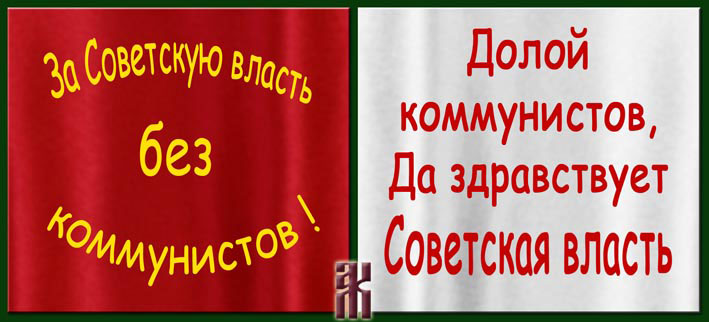
Banners of the Kolyvan' rebels
The West Siberian Uprising: Tobol'sk and Tyumen Regions (February-May 1921)
The most cohesive and organised group of rebels controlled Tobol'sk and its district, and also extended their power to the north of Western Siberia (Berezovsk, Surgut, and part of the Turinsk districts of the Tyumen' province). The highest powers in the territory liberated from the communists were the headquarters of the People's Army and the Tobol'sk Peasant-Town Soviet.
The rebels were in the ancient capital of Siberia from 21 February to 8 April 1921. During their retreat from Tobol'sk under pressure from Red Army units, the military leadership, institutions and archives were evacuated to Samarovo (now Khanty-Mansiysk). The "partisans" held out there for about another month. After the fall of Samarovo on 11 May, a central administration of the anti-Bolshevik movement in northern Tobol'sk ceased to exist. Its main leaders were killed, captured or went into hiding. However, in remote villages and hamlets, the rebel authorities continued to operate until early June, when navigation was finally established and punitive detachments arrived.
The red flag was chosen as the state symbol in Tobol'sk. Writer and local historian K. Ya. Logunov linked this circumstance to the influence of the Socialist Revolutionaries: "... they made the Soviet red banner the official "partisan" flag of the anti-Soviet movement, inscribing on it: "God is with us! Long live Soviet power and the Siberian peasantry! Down with the communists!". {6} It is difficult to agree with the opinion that the colour red was inevitably associated – at least during that period – with Bolshevik Soviet power. The red banner as a state symbol was used in 1918 mainly by the Committee of Members of the Constituent Assembly (KOMUCH), which was composed of Socialist Revolutionaries. The symbolism of the colour red was also used by Antonov's forces in the Tambov region. According to P. I. Loparev, during his unit's battle with the rebels near Pogu-Shaim (Turinsky district, Tyumen province) on 31 March 1921, a red flag was attached to the enemy's headquarters.{8} Red commander Loparev saw this as a military ruse, an attempt to mislead, but such a judgement can hardly be considered justified.
According to the memoirs of I. P. Volkov, commander of the Obdorsk radio station, in the Tobol'sk North, the rebels used not only red flags but also two-coloured red and green flags: "The kulak gangs were eagerly painting themselves red. They called themselves the People's Army and marched under red and green banners. The cockade was replaced with diagonal red and green stripes. Their banners bore slogans such as "Down with the Communists", "Long live the Soviets!" and "Long live the Soviets without the Communists!".{9} Volkov describes the use of rebel symbols as one of the tricks that allowed them to take the enemy by surprise: "... a platoon of Red Army soldiers approached the Samara pier under a red and green banner and disarmed the bandit leaders who had come out to meet the distinguished guests". {10}
The Tobol'sk rebels used "La Marseillaise" – the anthem of Russia between February 1917 and January 1918 – as their anthem on particularly solemn occasions, such as the opening of meetings of the peasant-town soviet.
(6) Logunov, K. Ya. in "Twenty-first: Chronicle of the West Siberian Peasant Uprising", Sverdlovsk. 1991, p.120.
(8) RGVA. F.25892 Op.3 D.1238 L.783.
(9) Volkov, I. P.in "In Obdorsk and Beyond the Urals [manuscript] // Tobolsk State Historical and Architectural Museum-Reserve. KP. No. 70", p.2.
(10) Ibid. p.24.
Tsys', V. in "The Red Banner with a Black Cross: Symbolism of the West Siberian Peasant Uprising of 1921 // Rodina, No. 6", Moscow, 2011, pp.110-111.
Prichumysh'e Uprising (January 1921)
Squadron under G. Svetlyakov, former partisan and commander of the Ovchinnikovsk detachment.
... we captured their headquarters in the village of Pogorelka and their tricolour banner: white, black in the middle, and brown at the bottom, with inscriptions at the top "For the Constituent Assembly", in the middle "For Mother Anarchy", and at the bottom "For pure Soviet power without communists".
"Memoirs of Titov K. G. on the peasant uprising in Prichumysh'e in January 1921" at ZFAKKM (Zarin branch of the Altai Regional Museum of Local History) I.N.-71 P-2 L.8-13
Based on materials from www.siberia.forum24.ru/?1-0-0-00000004-000-0-1-1253453845.
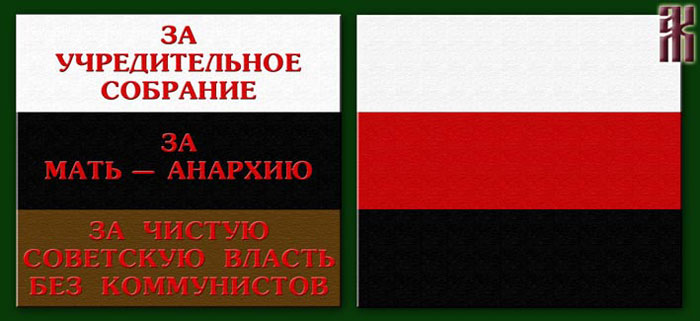
1 - The rebel banner, captured during the battle on 13 January 1921 at Pogorelka, Titovka parish, Barnaul district, by units of the 232nd Regiment of the Red 5th Army (The concept for the reconstruction came from I. A. Likhanov)
2 - The rebel banner from Telezhikha
From the memoirs of Vasily Shvetsov, Telezhikha village:
Fepen Fedorovich Dudarev, a sixty-year-old Old Believer, former partisan, who voluntarily took on the duties of honorary standard-bearer, scraped the pole with glass. The banner was sewn from three colours. The top stripe was white, the middle one was red, and the bottom one was black. On occasion, Fepen explained:
The white is for Emperor Nicholas, the red is for our peasants – we were red and defeated the whites – and the black is for the communists, the commissars and the Jews. They usurped power and took everything from us. This banner represents all of Russia."
He had also carried a banner as a partisan in 1919, but that was solely a red one, for the second squadron commanded by Kolesnikov.
Based on materials from www.siberia.forum24.ru/?1-0-0-00000004-000-0-1-1253453845.
Ishim Uprising (1921)
Information from the HQ of the rebel People's Army of Lapushina Volost, Kurgan Uyezd, to the military commander of Lebyazh'e Volost, 19 February 1921
The headquarters of the Lapushina People's Army establishes a flag and slogan for the rebellious people: a green flag, signifying the forests, meadows, and crops in the fields of the hard-working peasants who enjoy them; the inscription on the flag in white letters signifies the Siberian snows; the slogan is "Down with communism! Long live the Soviets!"
Headquarters of the Lapushina People's Army [signature illegible].
Yakovlev, A. N. (ed) and Shishkin, V. I. in "Siberian Vendée: Documents, Volume 2 (1920-1921)", Moscow, 2001, p.233 citing GAOPDKO F.6478 Op.1 D.2 L. 79.
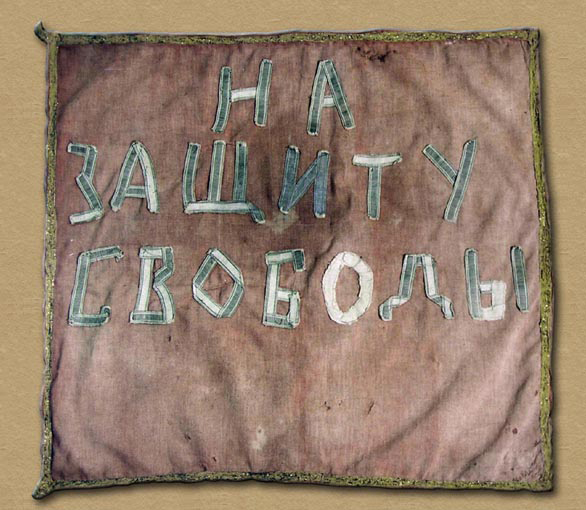
Banner of one of the rebel units of the People's Army in the Ishim uprising of 1921
www.gulagmuseum.org [link dead]
The banner is red cloth with gold braid. The inscription "For the defence of freedom" is made of silver braid. Captured by the Red Army, now kept in the archives of the Central Museum of the Armed Forces (Moscow).
Intelligence report from the HQ of the Soviet group in the Omsk-Tyumen region. Ishim Station. 9 March 1921
Another intercepted order establishes the flag and slogan of the rebellious people. The colour is green, signifying the forests and crops in the fields of the hard-working peasants, and white, signifying the Siberian snows. The slogan is "Down with communism, long live the Soviets!" In the area of the uprising, congresses are urgently being convened on the organisation of the People's Army and the restoration of iron discipline, as well as the transfer of overall command to a single person. The locations of the congresses are unknown. According to information from defectors and captured prisoners, it has been established that Red Army prisoners who surrendered voluntarily are being sent to the city of Tobol'sk. From there, reinforcements of weapons and ammunition are coming. The arriving soldiers wear a white bow, the old Tsarist insignia, on their chests.
Chief of Staff, Pechenin
Military Commissar, Kornakov
Yakovlev, A. N. (ed) and Shishkin, V. I. in "Siberian Vendée: Documents, Volume 2 (1920-1921)", Moscow, 2001, pp.278-279 citing RGVA F. 16750 Op.1 D.41 L. 261.
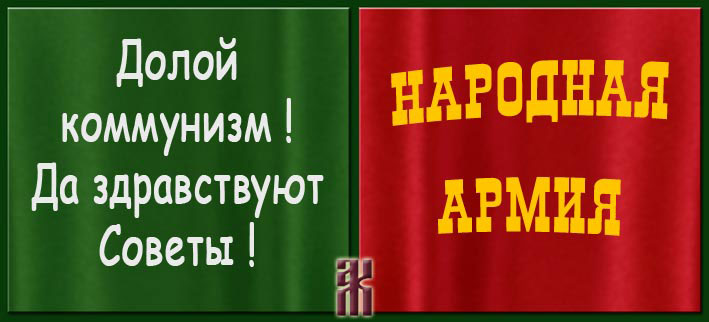
The banner of the Ishim uprising / The banner of Bulatov's detachment
Report by N. N. Rakhmanov, commander of the 85th Rifle Brigade, to V. I. Shorin, deputy head of the Siberian region, "Operation to suppress the insurgent movement in the Tyumen province from 10 February to 24 March 1921".
The uprising began under various slogans. In the Krotovka district, a red banner with a black cross and the inscription "We are fighting for bread. Don't rot it in the barns" was captured. In the Armizonskoe district, a green banner (symbolising green fields) was captured with the words "Down with communism" written in white letters (representing the Siberian snows). In the Kuserak district, a tricolour banner (with crimson colours) was captured with the demand [to bring] Prince Mikhail Alexandrovich to power.
One of the first slogans was "Long live free trade." Most often, however, the slogans "Down with the communists", "Long live the non-party soviets of peasant deputies", "All power to the peasants", etc. were repeated in various forms. The slogan demanding the removal of the Communists from power remained unchanged and was splashed across all appeals, flags, reports, and orders from headquarters. In some cases, the latter placed the slogan "Down with the Communists" at the top of all correspondence with other headquarters or units.
"For Soviets without Communists: Peasant uprising in the Tyumen province, 1921: Collection of documents", Novosibirsk, 2000 citing RGVA F.1345 Op.2 D.17 L.13-20.
www.alexanderyakovlev.org/fond/issues-doc/1000333
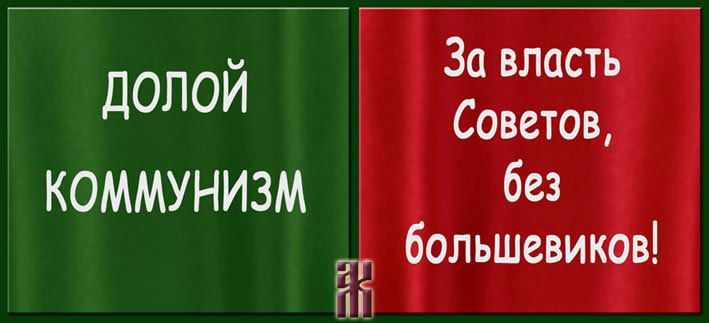
Banners of peasant rebels from the Armizonskoe district of the Tyumen province (1921) and the Altai Mountains (1930)
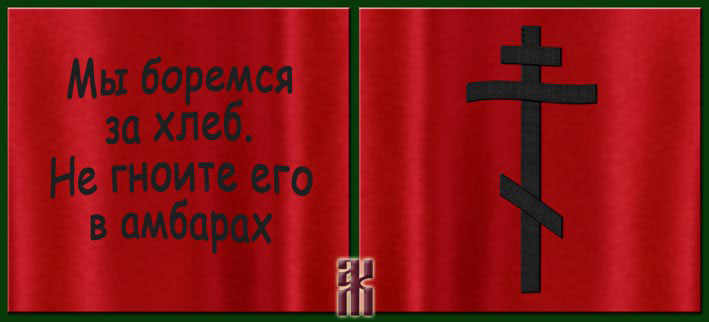
Banner of peasant rebels from the Krotovka district of the Tyumen province
Report by the military commissar of the Soviet group of troops in the Omsk-Tyumen region, Kornakov, to the head of the political administration of the Siberian troops, "On work on the Omsk-Tyumen rebel front". Unknown place. 9 March 1921.
Politically, the rebels relied mainly on the peasantry's dissatisfaction with the Soviet food policy and tried to present themselves as defenders against the communists. It is impossible to determine their ultimate goal. And, as can be seen, there was no clearly expressed, strictly defined, uniform [goal], even for the leaders. In most cases, the principle of Soviet power remained, but the parishes were immediately given the right to re-elect councils and bring in elements that would actively support the rebels. Most of the appeals were based on soviets, but without communists, calling themselves the true representatives of the people. Sometimes there were appeals with SR slogans, but there was no clear programme. The masses were filled with blind discontent without any indication of a final outcome. Very often the slogans were monarchist, and tricolour banners even appeared.
Yakovlev, A. N. (ed) and Shishkin, V. I. in "Siberian Vendée: Documents, Volume 2 (1920-1921)", Moscow, 2001, p.373 citing RGVA F.16 Op.2 D.88 L.29. and RGVA F.28149 Op.1 D.1 L.26.
Bulatov's Group (1920-1921)
From the intelligence report of the headquarters of the Trans-Ural Military District. Ekaterinburg. 21 April 1921.
Kurgan District. Bandits totalling up to 2,000 men on 500 infantry carts and 300 cavalry, armed with rifles [with] a small number of cartridges, with eight machine guns under the overall command of Bulatov, are grouped in the Privol'noe area (50 km southeast of Lebyazh'e Station) – Kaban'e (20 km south-west of Privol'noe) – Presnovka (40 km north-east of Kaban'e). Thanks to their good horses, the bandits move quickly, carrying out surprise raids. In the aforementioned area, bandits have killed 50 communists and captured a telegraph machine and a telegraph operator. The bandits wear Red Army badges and ribbons, have a red banner with the inscription "People's Army", a mobile workshop for loading cartridges, and a typewriter.
Acting Head of the PriUrVO [Pre-Urals Military District] Kuleshov, Commissar Fokin.
Yakovlev, A. N. (ed) and Shishkin, V. I. in "Siberian Vendée: Documents, Volume 2 (1920-1921)", Moscow, 2001, p.491 citing RGVA F.25892 Op.3. D.126 L.165.
Political report of the Tyumen Provincial Committee of the Russian Communist Party (Bolshevik) for February-March 1921. Tyumen. April 1921.
The political nature of the uprisings was initially quite varied, but then, with the White Army's occupation of Tobol'sk, it became much more uniform along the lines of the Socialist-Revolutionaries. Here are the most characteristic slogans:
1. "Down with the Communists, long live Soviet power",
2. "Free trade",
3. "Long live the Provisional Government, down with the communists and bread requisitions",
4. "Death to the communists, long live Soviet power",
5 "Long live the Constituent Assembly",
6. "Down with the communists, we don't need comrades",
7. Finally, the most colourful: a black banner with white letters reading "God and Tsar Mikhail II are with us",
The slogans in the Tobol'sk region (the realm of the Socialist Revolutionaries and, to some extent, the Kadets) were much more restrained and straightforward:
1. "Down with the Communists, long live the farmers",
2. "Power should belong to the whole people, not to any one group or party",
3. "Long live free labour in a free state",
4. "Only power that protects the power of the workers is lasting",
5. "Long live free Siberia, long live free Russia".
But the most characteristic and common slogan was: "Down with the Communists, long live Soviet power" or "Long live the power of the people, but without the Communists." Other Black Hundred slogans were observed in some places when the frenzied kulaks could not keep up the tone and slipped out from under their more sensible leaders. These practical slogans found application (apart from the quite understandable wholesale destruction of the communists) in the construction of the rebels' new power.
Secretary of the Tyumen Provincial Committee of the RCP, Sergei Aggeev
Yakovlev, A. N. (ed) and Shishkin, V. I. in "Siberian Vendée: Documents, Volume 2 (1920-1921)", Moscow, 2001, p.688 citing TsTsOSO F.1494 Op.1 D.41 Ll.16-23.
Report from the Tebenyakskoe Parish Revolutionary Committee to the Kurgan District Executive Committee of Soviets. Unknown place. 21 February 1921.
The Parish Revolutionary Committee hereby reports that on the night of 9 February, a gang of unknown origin arrived from the Brylinsk Parish under the banner "Down with the Communists! Long live the power of the peasants!"
Chairman of the Revolutionary Committee [signature illegible]
Secretary [signature illegible].
Yakovlev, A. N. (ed) and Shishkin, V. I. in "Siberian Vendée: Documents, Volume 2 (1920-1921)", Moscow, 2001, p.248 citing GAKO. F.r567 Op.2 D.2 L.62.
Secret intelligence report from the headquarters of the 115th Rifle Brigade. Tyumen, 17 May 1921.
According to information provided by Red Army soldiers who escaped from bandit captivity, Ivan Tkachenko and Vasily Troshev of the 1st Company of the 183rd Regiment; and Alexander Belyaev, a student of the Ekaterinburg sports school; the gang calling itself the 2nd Liberation Regiment has 700 bandits armed with various weapons, most of them three-line [7.62 mm] rifles. There are also about 300-400 unarmed men. The regiment has two battalions, a commander's komand, and a harvest and supply unit with a train of wagons. The regiment is commanded by Varaksin from Mostovskoe, the 1st Battalion by Vaganov (origin unknown), the 2nd Battalion by Baikalov from Dvortsy village in Shatrovo parish, the cavalry detachment by Funin from across the Iset River (the exact village is unknown), his assistant is Gubin, and Varaksin's assistant is Nyagin. In addition to rifles, the bandit regiment has six machine guns, one of which is a Colt, five are Maxim, and there are two automatic rifles. There is a shortage of ammunition, although there are twelve full belts for the Maxim machine guns, and the bandits collect ammunition for the other machine guns from the companies, as much as anyone can give. They obtain ammunition exclusively by capturing individual or small reconnaissance parties of Red Army soldiers and workers of the Soviets.
NachStabBrig-115 [Chief of Staff of 115th Brigade], Vedernikov
Military Commissar Popov
Yakovlev, A. N. (ed) and Shishkin, V. I. in "Siberian Vendée: Documents, Volume 2 (1920-1921)", Moscow, 2001, p.511 citing RGVA F.17718 Op.1 D.73 L.385.
Tobol'sk Uprising (1921)
Report from P. I. Loparev, commander of the Northern Volunteer Detachment, to A. B. Polisonov, commander of the 115th Rifle Brigade. Tyumen. Early June 1921.
Advancing [and having covered] 80 kms on 31 March along a forest road completely blocked by the enemy, with a deep ski detour, my detachment drove the rebels out of their well-fortified position [in] Polushaim, located 10 km south of Shaim, after a two-hour battle. It is noteworthy that, in addition to four trenches, the bandits tried to lure us into a trap with a red flag at their headquarters. Retreating, [they] left a mass of appeals along the road, calling on the Red Army soldiers to switch sides.
Commander of the Northern Volunteer Detachment, Loparev.
Yakovlev, A. N. (ed) and Shishkin, V. I. in "Siberian Vendée: Documents, Volume 2 (1920-1921)", Moscow, 2001, p.524 citing TsTsOOSO. F.41 Op.1 D.141 Ll.46-48.
General Bakich's People's Revolutionary Army (1921-1922)
A red banner flew above the headquarters of the Orenburg Army in Shara-Sume. In its upper corner, near the pole, was a tiny tricolour rectangle sewn in. They even wanted to abolish shoulder-boards, but the officers protested. Bakich had to justify himself: "We wear shoulder-boards not to pay homage, but to distinguish our side [from the enemy]." There was a certain desire to please in his explanations, aimed at the peasant rebels: "It is not uncommon to find a colonel with one, two or three stripes in our ranks, which means that the colonel serves almost as a private, while a former ploughman commands him."
Yuzhefovich, L. in "The Autocrat of the Desert: The Phenomenon of the Fate of Baron R. F. Ungern-Sternberg", Moscow, 1993, p.170.
Shara-Sume. July-August 1921.
In those days, Bakich was actively preparing for a campaign in Russia. ... A People's Revolutionary Army was formed, headed by the Supreme Commander-in-Chief, which included the Separate Orenburg Corps. ... A flag was prepared, representing a mixture of the red and old Russian flags – a symbol of the reconciliation of the old (White) and new (peasant rebels) currents in the struggle against the Bolsheviks.
Noskov, K. in "The Black Year or the Adventures of the Russian Whites in Mongolia in 1921", Harbin, 1930, p.49.
Ganin, A.V. in (A Montenegrin in Russian Service: General Bakich", Moscow, 2004, pp.152-153.
The People's Division of S. G. Tokarev. This unit arose in connection with the Petropavlovsk Uprising of February-May 1921. In early May 1921 it arrived at the camp of Chugunchak (China) to join with Bakich's forces.
After staying at the border for a while, the new arrivals sent out scouts, who found the camp. Then, without surrendering their weapons, they crossed the border and, passing through the Chinese troops that had been pulled back from the border, arrived at Bakich's camp. These were Tokarev's men. Following on the events in Petropavlovsk, they raised an uprising in Karakalinsk and, after committing all sorts of atrocities there, fled to the steppes and then headed for China to find Dutov and join his army. ...
In any case, the red flag which the newcomers carried threw the [Bakich] detachment headquarters into great confusion. But the Tokarevtsy had weapons and there were more than two thousand of them, so it was necessary to come to terms. There were no major difficulties. Here, at Emil-Kho, there were uniforms ready, open arms, and Tokarev's men (politically similar to the SRs), recognising Bakich's command. They joined the corps under the name of the 1st Siberian Division and Tokarev himself was promoted to some rank.
Kamskiy, V. in "The Russian White Guards in China", Moscow, 1923, p.63.
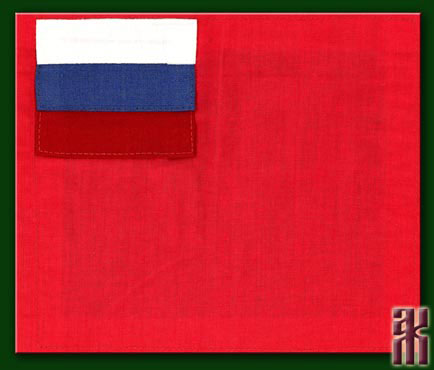
Reconstruction of the flag of General Bakich's People's Revolutionary Army
Sapozhkov's Uprising, Samara Province (1920-1922)
According to an eyewitness, the red banner of the rebels who entered Buzuluk had the words "Ros. Sov. Social. Resp." written in small letters at the top and "Down with eggs and butter, long live salt!" in large letters in the middle. In conversation, some of the rebels claimed that they supported Soviet power. They promised to allow free trade, disperse the regional food committees and communists, and hold new elections for the soviets. The reasons given for the uprising were dissatisfaction with the food policy of the "communists entrenched in power" and the latest rationing of butter and eggs by the provincial food committee.
"Civil War in the Volga Region", Moscow, 1974, p. 305.
Irkutsk Province Uprising (1921)
In addition to those mentioned above, in 1921 there were Muravyin's detachment (assisted by Ensign M. Zverev) with 150 men, the "lame colonel" with up to 300 men, Petrov's detachment of 150 rebels, and Ensign Romanenko and Tatarkin's detachment of 40 men. The detachments did not have any striking political slogans; their banners bore the following inscriptions: "Blue water will flood communism" and, in Romanenko's case, "Beat the Jews, save Russia".
Lushchayeva, G. M. in "Partisan warfare in the Irkutsk province in the early 1920s // Reports of the Academy of Military Sciences, No. 3 (38)", 2009. p.115. Published at www.sgu.ru/files/nodes/10094/Doklady_AVN. _Partizanskiy_sbornik.pdf
Western Kazakhstan Uprising (October 1921-March 1922)
Flag of 1st Ataman Division of Ataman Serov's "Will of the People" rebel army. [1]
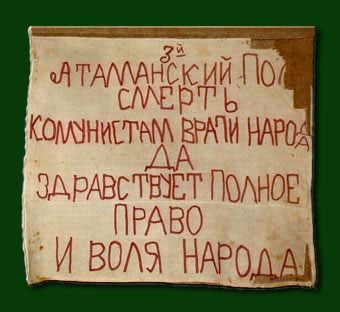
Captured by the Soviets during the defeat of Serov's detachment near the village of Krasny Yar (Uilsk District). Currently on display at the State Central Museum of Contemporary History of Russia (Moscow).
www.sovr.ru/expo/e6/znambel.shtml
Altai Mountains Uprisings (1920-30s)
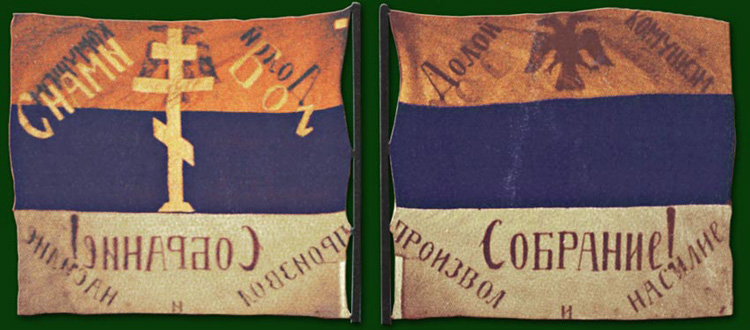
The banner of one of the rebel units
A red, blue and white double-sided banner. On the front side, a black double-headed eagle without state regalia is depicted on the red stripe. On the blue and white stripes, there is an inscription in two lines: "Long live the Constituent Assembly". In the corners is the inscription: "Down with communism, tyranny, and violence". On the reverse there is an eight-pointed Orthodox cross is sewn from white braid in the centre, flanked by the motto: "God is with us".
The banner was captured by units of the Red Army during the suppression of the West Siberian uprising. It is stored in the banner collection of the Central Museum of the Armed Forces in Moscow.
Photo from the book: Karpov, N. D. "The Crusaders: Kolchak's Last Reserve", Moscow, 2014.
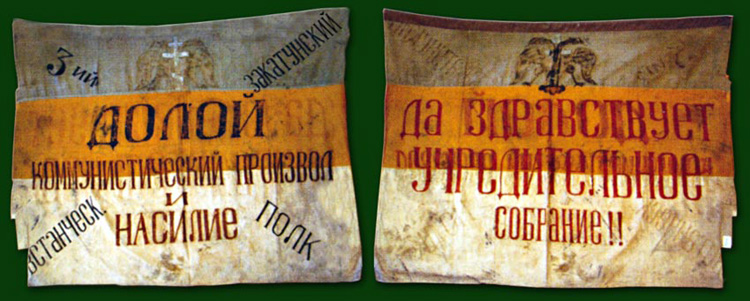
The banner of the 3rd Zakatun Rebel Regiment
A black, orange and white double-sided banner. [2] On the front is an oil painting depicting a double-headed eagle without state regalia. Below it is an inscription in red paint in three lines: "Long live // the Constituent // Assembly!!". On the reverse side, at the top, there is an image of an eight-pointed Orthodox cross, beneath which, in the centre, there is an inscription in four lines: "Down // with Communist arbitrariness // and // violence" and in the corners is the name of the unit: "3rd Zakatun Rebel Regiment".
The banner was captured by units of the Red Army during the suppression of the West Siberian uprising. It is stored in the banner collection of the Central Museum of the Armed Forces in Moscow.
Photo from the book: Karpov, N. D. "The Crusaders: Kolchak's Last Reserve", Moscow, 2014.
In Altai in 1920-1922, an anti-Soviet uprising was led by Kolchak supporters Slovaevskiy and Shtanakov. The rebels were opposed by ChON troops. In the village of Ynyrga-Nikolskoe, the ChON troops captured the rebels' banner, which was "two-coloured with a double-headed eagle and a cross".
Grishaev, V. F. in "At Lake Teletskoe" at www.vexillographia.ru/russia/beloe.htm.
Summer 1930.
We were walking along a quiet little river through a ravine between low mountains. Suddenly, my father pushed me into the bushes and then followed me. Ahead of us, across the ravine, a band of rebels on horseback was descending from one slope to another, carrying a red banner. The banner fluttered in the wind, and I read: "For Soviet power, without the Bolsheviks!"
Somov, K. in "Fire on our own // Altai Pravda, No. 17-19", 25 January 2008 at www.ap.altairegion.ru/017-08/5.html
October 1930.
In October 1930, a gang led by Tuzhley and Atamanov became active in the Ongudai district.
They held a general meeting and, at Atamanov's suggestion, made a flag. They sewed pieces of blue fabric onto a white cloth, depicting Belukha, Katun, the sun and the moon, and in the lower right corner, a Kerzhat cross made of yellow rags.
They set off for the village of Kupchegen under this flag on 8 February 1930. The plan was to head through Kupchegen, to Khabarovka, to Ongudai (about 40 km), to capture the aimak centre and secure it. After that, Tuzhley and the Altai people would remain in place to wait for Ataman Semenov, while Vasily Atamanov and the Russians would go to Belaya Anaya and Uymon to stir up an uprising.
Biography of Pavel Kondratievich Alferov, representative of the Oirot District Department of the OGPU at mus.school8gornya.edusite.ru/p5aa1.html

Flags of the Mountain Altai rebels: Slovaevskiy's detachment and Tuzhlyev-Artamonov's detachment
Summary from 17 January 1922, when Slovaevskiy's group was in the Altai region.
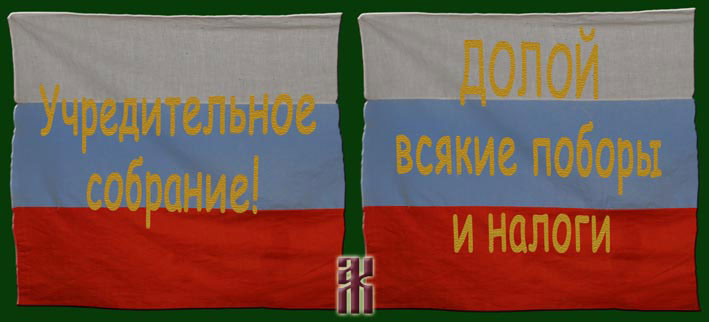
The gang has tricolour flags with the slogans "Constituent Assembly!" and "Down with all kinds of levies and taxes!" According to information from 18 January, the main forces of Chekurkov-Kaigorodov's gangs, numbering 150 people, are in the area of the Bertvem River, a right tributary of the Katun River.
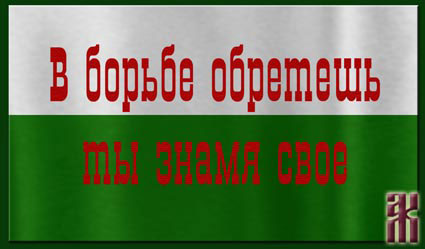
In the summer of 1920, Shcheglov's organisation was uncovered in the Tomsk province. The uprising was planned for 3 August, but was prevented by arrests. The case was referred to the revolutionary tribunal. That was the end of it. The uprising did not pose a serious threat, but it served as a pretext for riots that took place in the province. When Shcheglov was arrested, a draft of a white and green banner was found with the words "In struggle you will find your banner".
www.siberia.forum24.ru/?1-8-0-00000006-000-0-0-1271923674
Summary No. 2 of the Shadrinsk District Politburo to the Secret Operations Department of the Ekaterinburg Provincial Cheka for the period from 11-26 January 1921. Shadrinsk. No earlier than 27 January 1921.
8. ... Counter-intelligence spotted a detachment on the border between Shadrinsk and Kurgan counties, which split into two groups, one of which headed towards Mishkino Station, and the other towards Zverinogolovsk Station. The detachments marched under white banners with slogans calling for the beating of important Soviet workers.
Head of the Political Bureau [signature illegible]
Informant [signature illegible]
Yakovlev, A. N. (ed) and Shishkin, V. I. in "Siberian Vendée: Documents, Volume 1 (1919-1920)", Moscow, 2000, p.101 citing GAOPDKO. F.2 0p.1 D.117 L.62, 63.
Zazeyvsk Uprising on the Amur River (January 1924)
In January 1924, mass discontent among Amur peasants erupted into the Zazeyvsk Uprising, which in the first few days spread across several peasant volosts (Gil'chinka, Tambovka, Peschanoozerka) and two former stanitsa districts (Nikolaevka and Konstantinovka). The total number of participants reached 5,000. The centre of the uprising was Tambovka. A Provisional Amur Regional Government was formed there, headed by field surgeon R. G. Cheshev. Cossacks N. I. Korzhenevskiy and N. N. Mankov were appointed commander and chief of staff of the rebel army. ... At the insistence of the Cossacks, the tricolour Russian flag became the symbol of the uprising. The men of Konstantinovka, seeing it flying above the volost administration, took off their hats and began to cross themselves, saying: "Thank God, now we will have our Tsar-father".
Pushkarev, V. A. in "The Historical Fate of the Amur Cossacks (1917-1945) // Dissertation for the degree of Candidate of Historical Sciences", Blagoveshchensk, 2015. pp.94-95.
Colonel Oliferov's Detachment, Zeledevskoe Uprising (October 1920-February 1921)
According to Soviet intelligence reports, at that time the detachment consisted of two companies, each with four platoons. Each platoon had 40 men. The command staff consisted of combat officers. They were armed with three-line rifles with 300 rounds of ammunition each. The convoy consisted of 120 carts, including 22 loaded with food. The detachment numbered 250-300 men, including 50 cavalrymen. Soviet officials in Eniseysk cited higher figures. Stepan Nakladov, for example, estimated the number of Oliferovtsy at 600.
According to Soviet sources, the detachment also had its own banner. It bore the inscription "God and Michael II are with us".
Eliseenko, A. and Marmyshev, A in "The Forgotten Ice Campaign // Siberian Historical Almanac, Vol 1: The Civil War in Siberia", Krasnoyarsk, 2010, p.147.
Amur Rebellion (1924)
Informing the population about events in the province, Amurskaya Pravda wrote on 25 January 1924 that "in early January, foreign White Guard organisations led by General Sychev began sending their agents to the Amur province to organise a rebellion against Soviet power. Having made their way into the Blagoveshchensk district, they gathered around them kulaks dissatisfied with taxes and raised a rebellion. A ""government" was immediately established, under whose leadership all the White rebels acted. The slogans used by the rebels were not particularly original, but were the same ones used earlier by the White Guards. First and foremost, they borrowed slogans such as "Long live the Constituent Assembly", "Down with the Communists" and others, bizarrely combining them with the tricolour flag and the singing of the Tsarist anthem "God Save the Tsar". The rebels directed their actions primarily at destroying the Soviet apparatus, killing those in workers' and village soviets, as well as Communists and Komsomol members.
It is characteristic that the rebels raised the Tsarist flag, thereby immediately defining their clearly counter-revolutionary nature. "After 15 January," wrote Amurskaya Pravda, "the entire border area of the Blagoveshchensk district became a place of rampant banditry. Having created their own "Provisional Government" and proclaiming the slogans: "Democracy and freedom", "All power to the Constituent Assembly", "Beat the Jews and Communists", they hoped to find support among the peasants. But despite these right-SR slogans, the White Bandits flew Tsarist tricolour flags, emphasising their monarchist aspirations.
http://voenoboz.ru/ [link dead]
By the end of January, the detachment had arrested a total of 295 active bandits and their accomplices. On 29 January, a gang of 70 people appeared in the Ekaterinoslavka area with a flag reading "Down with the communists, down with taxes".
http://voenoboz.ru/ [link dead].
Biysk District Uprising (August-September 1930)
At the junction of the Sychevka, Altai and Kuyagan districts, bordering the Shebalino aimak of the Oirot region, a gang of unknown command, number and armament is operating. On 5 August, one of the groups of this gang, numbering about 20 people, raided shepherds grazing the commune's cattle. Seven horses, four saddles and some food were seized. On 7 August, a band of about 17 horsemen armed with three-line rifles and shotguns wounded the commandant of a kulak special settlement located near the village of Osinovskoe in the Sychevka district. On 9 August, a gang of 25 people raided the village of Dresvyanka in the Sychevka district, where they killed the chairman of the agricultural cooperative. Among the bandits, the collective farmers identified Shevelev, a middle-class member of the cooperative in this village. The gang operates in separate groups and has a flag with the inscriptions: "Down with Soviet power, down with communism and communes! Long live the old power!".
http://istmat.info/node/27126 [link dead]
Minusinsk District Uprising (1930)
OGPU excerpts from village documents sent to the Red Army, July 1930.
SibKrai
Barnaul, OGPU cavalry division.
I report that not long ago a gang came out of the taiga. They began to raid the communes, but they were soon caught and destroyed. When they entered the village of Kuchibar, they set up their own zemstvo, raised their black flag, and then when they were driven out, they did not have time to take their flag with them. There were 30 of them. The OGPU arrived from Minusinsk and immediately caught them all, cutting off their heads and taking the rest away with them.
http://istmat.info/node/26698 [link dead]
Home — State Symbols — Flags — Uniforms — Badges & Medals — Money — Other
Pygmy Wars Notes
The original of this page is at kolchakiya.ru/vexillology/insurgent_flags_21-22.htm.
1) The flag is for Western Kazakhstan Uprising is for the "3rd Ataman Regiment", not the division as a whole. After it says "Death to the Communists, enemies of the people, long live the full rights and will of the people".