
Uniforms of the Czecho-Slovak Legion Military Doctors and Veterinarians, 1917-1920
All material and reconstructions are by A. Karevskiy.
The main sources for this material are:
Tatarov, B. "Czechoslovak Military Formations in Russia: Part 1, 1917-1918 // Staryi Tseykhgauz, No. 5-6", Moscow, 2015. pp. 54-76; and " ... Part 2, 1919-1920 // Staryi Tseykhgauz, No. 3", Moscow, 2016, pp.73-83.
Tatarov, B. and Panush, B. "Czechoslovak Units in Russia, 1914-1917 // Tseykhgauz, No. 4", Moscow, 2001, pp.28-35.
Orian, E., Panus, B., Stechlik, E. and Steidler, F. "Ceskoslovenska Legie v Rusku, 1914-1920", Prague, 2014.
Bullock, D. "The Czech Legion // Men-at-Arms No. 447", Oxford, 2007.
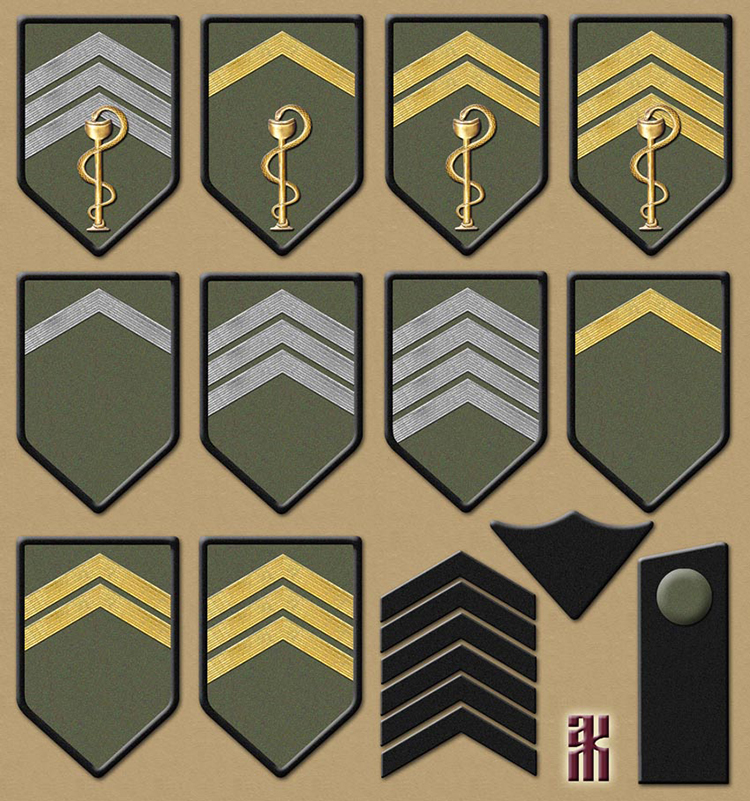
Insignia of military medical personnel:
First row: sleeve badges as per the 30 December 1917 order:
1 – junior doctor; 2 – senior doctor; 3 – divisional doctor; 4 – corps doctor:
Second and third rows: insignia of the Medical service, as per the 27 October 1918 order:
5 – ensign (assistant doctor); 6 – lieutenant (deputy doctor);
7 – staff captain (junior doctor);8 – captain (senior doctor of the unit, hospital resident);
9 – lieutenant colonel (brigade or divisional doctor, head of the divisional hospital,
head of the medical service of a brigade or division);
10 – colonel (head of the corps medical service, corps doctor)
11 – service stripes; 12 – "Vladivostok uniform" tunic collar tab; 13 – greatcoat collar tab
Order No. 15 of 30 December 1917:
§4. For doctors, the piping around the shield is black cloth or velvet.
§5. The number of the unit (regiment, artillery brigade, engineer company) is written in Arabic numerals in the pointed corner of the shield ..., and in special-purpose units and teams, specialist insignia are placed under the number.
§6. For doctors, distinctions are by rank.
In accordance with Corps Order No. 49 of 8 April 1918, military ranks were introduced for military medical staff.
Order No. 117 of 27 October 1918:
§7. The branches of the armed forces and services are distinguished by the colour of the piping on the sleeve shields and the buttonhole tabs on the collars of their overcoats. It is established that medical units shall be black.
Order No. 117 also replaced the rank of staff captain with that of captain, and the rank of captain with that of major.
The button of the greatcoat tab is covered by cloth, as was required for buttons bearing the image of the coat of arms of the Russian Empire. The so-called "Vladivostok uniform" was introduced into the Czechoslovakian army by Order No. 41 of 21 June 1919. The chevrons for service were established by Order No. 11 of 27 October 1918. One was awarded for each full year of service (starting from the beginning of the Czech druzhina).
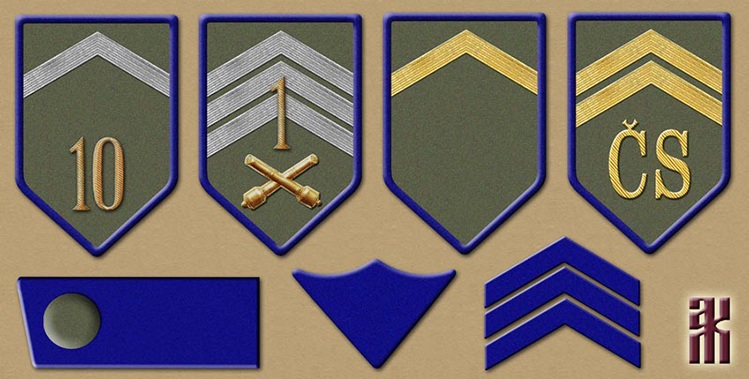
Insignia of personnel of the veterinary service:
1 – ensign (assistant veterinarian); 2 – lieutenant (veterinarian);
3 – captain (senior vet); 4 – lieutenant colonel (head of the corps veterinary department);
5 – overcoat buttonhole tab; 6 – collar tab for "Vladivostok uniform" tunics;
7 – service chevrons
Order No. 117 of 27 October 1918.
§7. Branches of service and services are distinguished by the colour of the piping on the uniform shields and the lapels on the collars of coats. It is established that the veterinary department shall be dark blue.
In accordance with Corps Order No. 49 of 8 April 1919, military ranks were introduced for military veterinarians
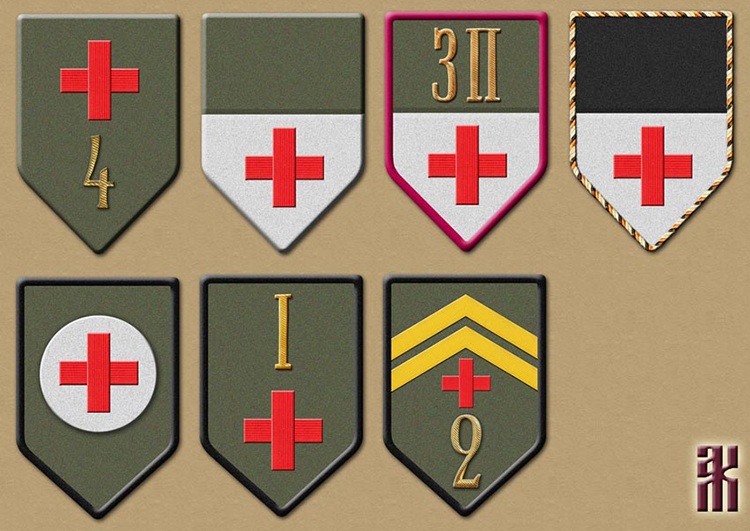
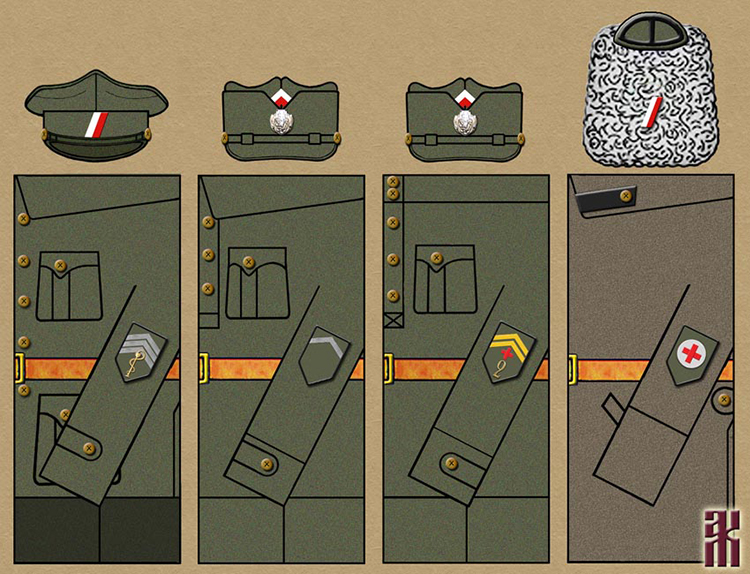
Sleeve badges of medical personnel in the combat units: 1 – paramedic of the 4th Regiment; 2 – unspecified; 3 – paramedic of the 1st Reserve Regiment;
4 – employee of the Siberian Committee of the Czechoslovakian Red Cross;
5 – unspecified; 6 – medical personnel of the HQ of the 1st Rifle Division;
7 – lance-corporal medic of the 2nd Rifle Regiment
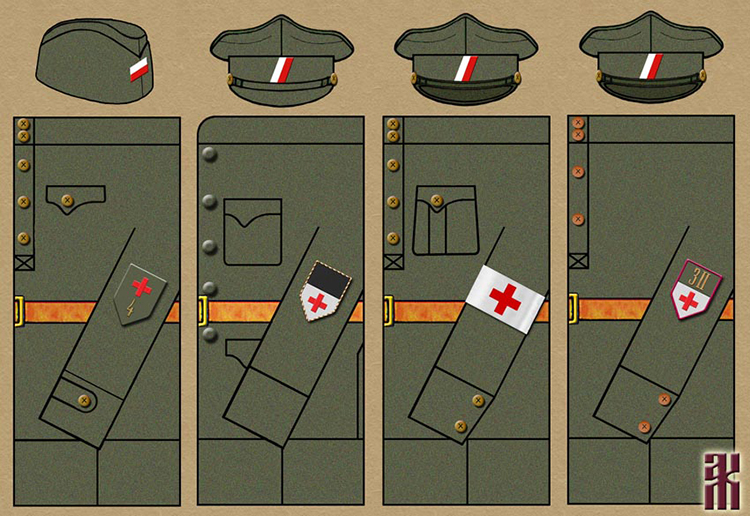
Uniforms of medical personnel of combat units: 1 – paramedic of the 4th Rifle Regiment;
2 and 3 – employees of the Siberian Committee of the Czechoslovak Red Cross;
4 – paramedic of the 1st Reserve Regiment
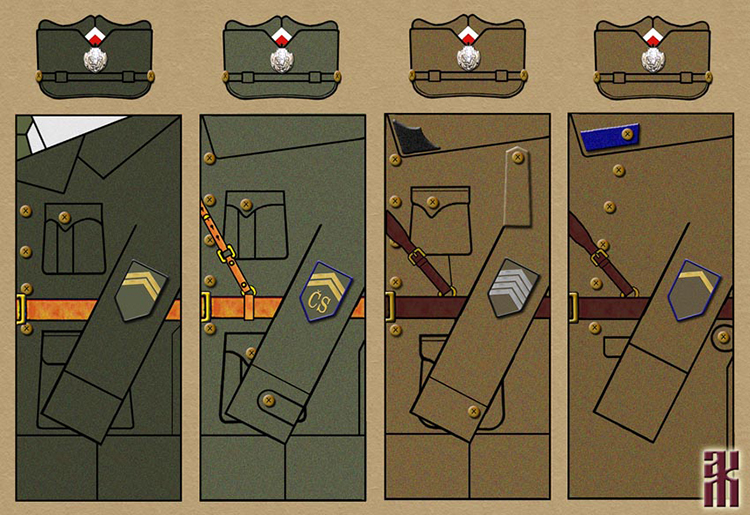
Uniforms of officers of the medical service and medics in various units:
1 – lieutenant, from December 1917 to October 1918; 2 – ensign, from June 1919;
3 – corporal medic of the 2nd Rifle Regiment; 4 – unspecified
Order No. 41 of 21 June 1919 introduced a new type of headgear in the Czechoslovak units, the "vydumka" shown in Figures 2 and 3, after which the wearing of other types of headgear was prohibited.
Uniforms of officers of the medical and veterinary services from July 1919 to 1920:
1 – lieutenant-colonel of the medical service in open tunic, similar in cut to the British one;
2 – lieutenant-colonel of the Veterinary Service, head of the corps' veterinary department;
3 – captain of the medical service in the tunic of the "Vladivostok uniform";
4 – major of the veterinary service in the overcoat of the "Vladivostok uniform"
The "Vladivostok uniform" was introduced in the Czechoslovak army by Order No. 41 of 21 June 1919. It initially applied only to officers (with permission to continue wearing the previous uniform until the end of 1919, provided that the new uniform was worn during all official events), but was later extended to other ranks. The introduction of a new model of overcoat, common to all branches of the armed forces, followed in August 1919.
Home — State Symbols — Flags — Uniforms — Badges & Medals — Money — Other