
Uniforms of the Czecho-Slovak Armoured Units, 1917-1920
All material and reconstructions are by A. Karevskiy.
The main sources for this material are:
Tatarov, B. "Czechoslovak Military Formations in Russia: Part 1, 1917-1918 // Staryi Tseykhgauz, No. 5-6", Moscow, 2015. pp. 54-76; and " ... Part 2, 1919-1920 // Staryi Tseykhgauz, No. 3", Moscow, 2016, pp.73-83.
Orian, E., Panus, B., Stechlik, E. and Steidler, F. "Ceskoslovenska Legie v Rusku, 1914-1920", Prague, 2014.
Bullock, D. "The Czech Legion // Men-at-Arms No. 447", Oxford, 2007.
Armoured Cars
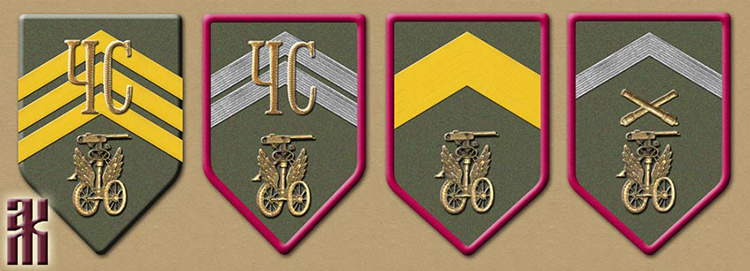
Sleeve badges of the crews of armoured vehicles of the Czechoslovak Corps:
1 and 2 – motorised company at Corps HQ, as per the 30 December 1917 order;
3 – crews of Austin-Putilov, Fiat-Izhorsk, and Jeffery A/Cs, as per the 27 October 1918 order;
4 – crews of Garford-Putilov A/Cs
The appearance of the sleeve insignia of armoured vehicle crews was not specifically stipulated: apparently the regulations applicable to motorised units also applied to them (Orders No. 15 of 30 December 1917 and No. 117 of 27 October 1918). It can be assumed that since armoured vehicles were constantly assigned to infantry units, their crews inherited the "rifle" raspberry piping.
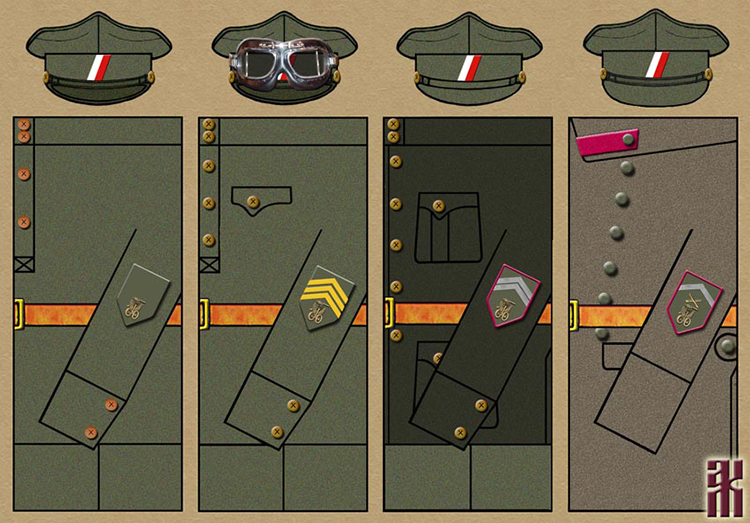
Uniforms of armoured car crews of the Czechoslovak Corps
A variety in the styles and cuts of outerwear was characteristic of armoured car crews, generally following the fashion of motorised units in both the Czechoslovak Corps and the former Russian Army. They inherited leather jackets and special "driver's" goggles.
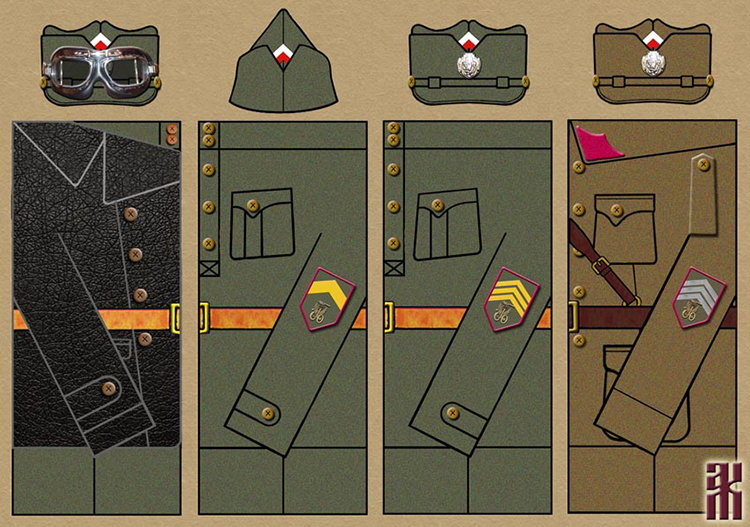
Uniforms of armoured car crews of the Czechoslovak Corps
Figure 1 shows a leather jacket, as had been assigned to the motorised units of the Russian army. Figure 2 shows a headdress modelled on the French sidecap, a pilotka, which became widespread in Czechoslovakian units from 1918 onwards. Figure 3 shows the most common version of the uniform from the summer of 1919, after the introduction in June 1919 of their own original headgear, the "vydumka", which became a characteristic feature of the Czechoslovaks, even while retaining the blouses and "French" tunics of the former Russian army. Figure 4 shows a so-called "Vladivostok uniform", introduced to the corps in June 1919, initially for officers and then extended to lower ranks.
Armoured Trains
This section is for the crews of the "permanent" armoured trains. The "improvised" trains were part of the rifle regiments, were manned by soldiers from the latter, and as such wore rifle insignia and uniforms.
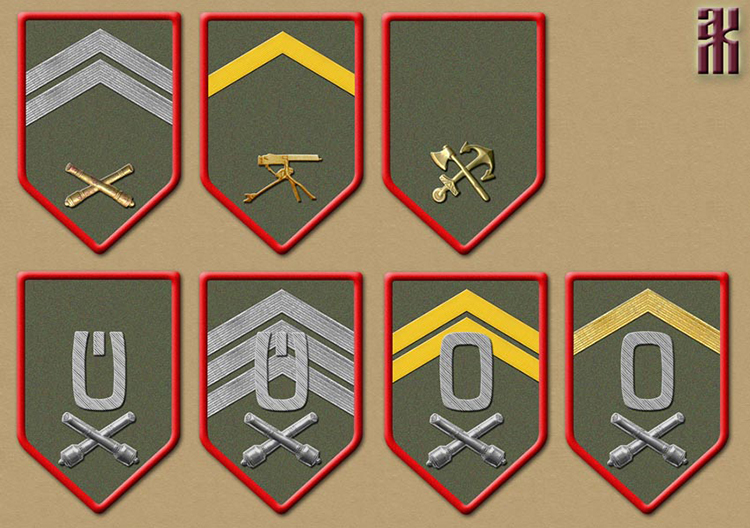
Insignia of armoured train crews of the Czechoslovak Corps:
1– gun crews; 2 – machine-gun crews; 3 – locomotive crews;
4 and 5 – crew of the Udarnik; 6 and 7 – crew of the Orlik
Figure 3 carries the emblem of the Ministry of Transport of the Russian Empire. The insignia for Figures 4 to 7 was established by Order No. 85 of 24 December 1919. Figure 7 is for the rank of major, which was worn by one of its commanders.
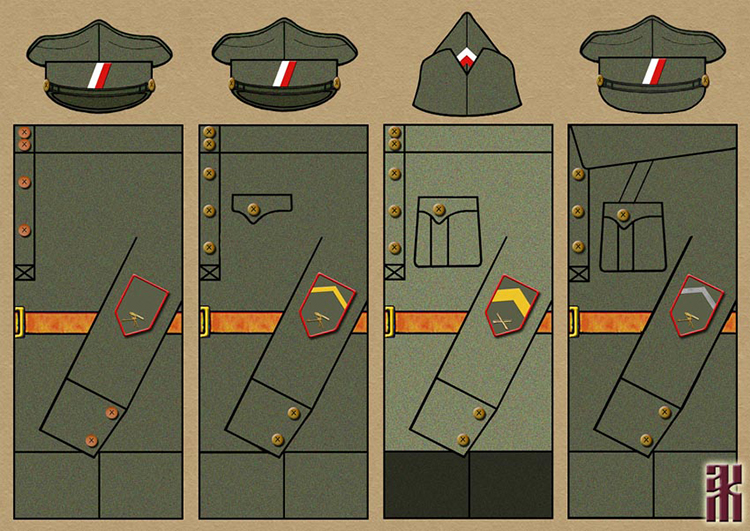
Uniforms of the armoured train crews of the Czechoslovak Corps
Judging from photographs, there was considerable variety in uniforms even within the crew of a single armoured train.
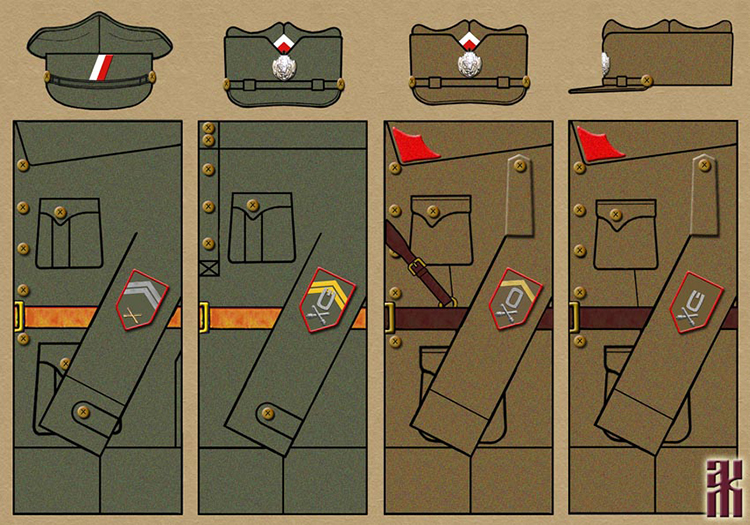
Uniforms of the armoured train crews of the Czechoslovak Corps
Figure 2 shows the most common version of the uniform from the summer of 1919, after the introduction in June 1919 of the vydumka headgear. Figures 3 and 4 represent the so-called "Vladivostok uniform", introduced in the Czechoslovak corps in June 1919, initially for officers, and then extended to lower ranks. Red "artillery" collar tabs became a characteristic feature of armoured train crews.
Home — State Symbols — Flags — Uniforms — Badges & Medals — Money — Other
Pygmy Wars Notes
The original for this page is at kolchakiya.ru/uniformology/czech/armor_units.htm.
Udarnik means "shock worker" and Orlik is "eagle".
Discussion on the translation choices I have made can be found here.