
Uniforms of Russian Units in the Shanghai International Settlement
All material and reconstructions are by A. Karevskiy unless noted otherwise.
Krasnousov, p..
On the same day, 19 October 1928, an order was issued announcing the formation of a Russian volunteer company within the Shanghai Volunteer Corps on the same basis as the companies of other nationalities that made up the corps. By order No. 1156 of the S.V.C. of the same day, the English name of the unit – "The Russian Unit of the S. V. C.", unlike the newly formed Russian Volunteer Company, was changed to "The Russian Detachment of the S. V. C.", and the "V" insignia worn on the shoulder-boards of the detachment's officers was removed. We became a regular part of the Shanghai Volunteer Corps.
Krasnousov, E. in "The Shanghai Russian Regiment // White Emigration in China and Mongolia", Moscow, 2005, p.193.
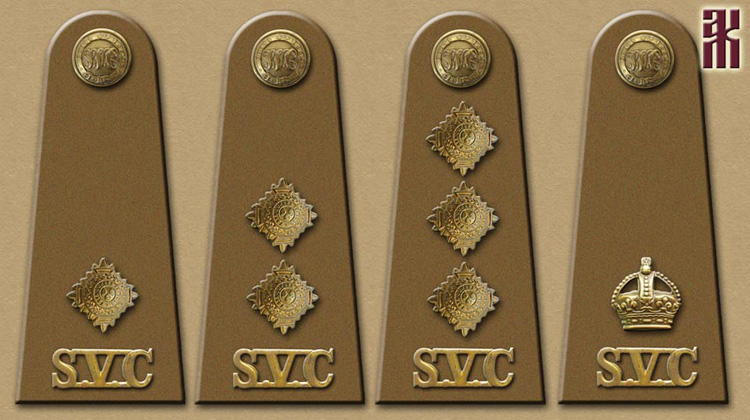
Rank markings of the Russian detachment of the Shanghai Volunteer Corps for officers:
1 – second lieutenant; 2 – lieutenant; 3 – captain; 4 – major
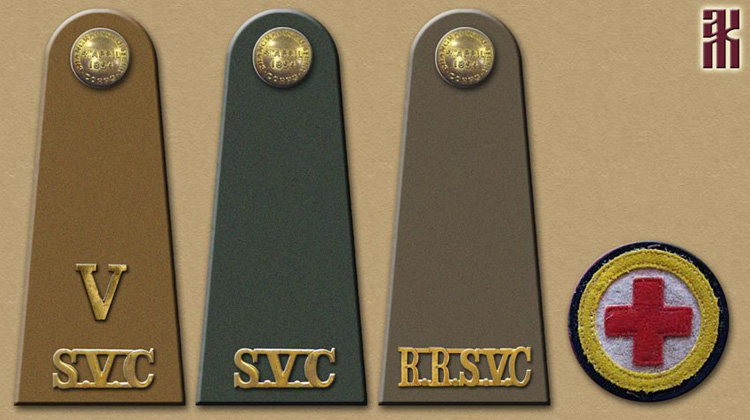
Insignia of the Russian detachment of the Shanghai Volunteer Corps (privates and NCOs):
1 – shoulder-board from the period 1927-1928;
2 – shoulder-board from the period 1928-1938;
3 – shoulder-board from the period 1938-1940
4 – sleeve insignia of lower ranks of the medical service.
The cipher "S. V. C." stood for "Shanghai Volunteers Corps" and the letter "V' for volunteer. The cipher "R.R.S.V.C." stood for "Russian Regiment of the Shanghai Volunteers Corps".
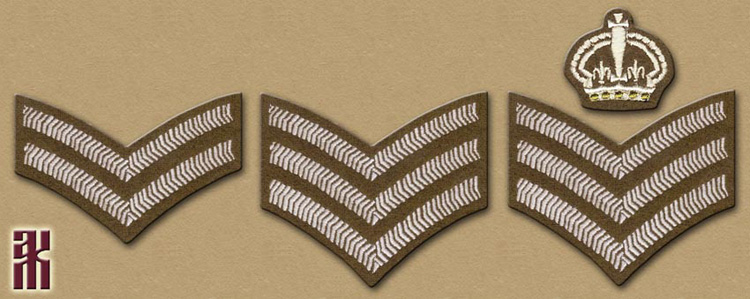
Rank markings of the Russian detachment of the Shanghai Volunteer Corps:
1 – corporal; 2 – sergeant; 3 – sergeant major (applied on both sleeves of the uniform)
23 October 1929
Shortly after the 1st Company was transferred to the municipality, the corps commander submitted a request (energetically supported by the commander of the British forces, General Barrett) for the detachment to be provided with special new uniforms. The request was granted, and the unit received new uniforms, tailor-made from excellent dark green cloth, similar in colour to the uniforms of the American Marines of the 4th Regiment stationed in Shanghai, but modelled on those of the British Army.
Krasnousov, p.210.
1931
The "supernumeraries" (their number was determined by order of the detachment) wore our old uniforms, which we had handed over to the corps' warehouses.
On 4 March 1932, after the formation of the 3rd Russian Volunteer Company and then the 4th Company (the third regular company), the detachment was renamed the "Russian Regiment of the SVC".
May 1932
An English soldier on leave in uniform had a [swagger] "stick" that complemented his "leave uniform". Several such sticks, unofficially of course, appeared in the regimental companies among the "most distinguished" and dapper NCOs. When company commanders learned of this, they initially disapproved, but the regiment commander who learned of this took a different view: the "stick" forced volunteers on leave to be more alert, if only because it eliminated the possibility of keeping their hands in their pockets, and at the same time decorated their uniforms.
The corresponding report to the corps headquarters was supported by the corps commander, and on 26 May, a model of the cap badge was established for all ranks of the regiment: the head was spherical, cast from yellow copper, silver-plated, with a smaller-sized "S.V.C." cockade soldered to the top. The side of the head was engraved with "Russian Regiment" (in English), and the volunteer's personal number was engraved on the neck of the head. The 28-inch-long shaft, with a silver-plated copper tip, was made of hardwood and blackened.
Krasnousov, p.239.
1934
With a view to emphasising the "Russianness" of the regiment, already partly expressed in the form of the regimental banner (the Russian tricolour flag with the coat of arms of the Shanghai Municipal Council), the regiment commander decided to request permission from the municipal authorities to hang the Russian tricolour flag in the places where the regiment's companies were stationed, and this permission was granted.
Krasnousov, p.266.
1936
Brought to near perfection, the regiment's drill training meant that the "volunteers" were indistinguishable in appearance from the English "regulars", as even their uniforms were now English army issue. The only thing that gave away the volunteers was the leather cartridge belts slung over their shoulders, a relic of the First World War. However again, apparently at the insistence of the British military command, that year the regiment was issued with "web" equipment – the equipment used in the British regular army. The leather cartridge belt became a thing of the past, as did the ugly canvas bag and the oval flask of the old model, each of which was worn separately and in a specific order to create uniformity of form. Instead, the entire set of equipment was now worn at the same time, including a cartridge pouch, flask, cover – holder for carrying a bayonet, and a knapsack. This set was heavier, but when properly fitted to the soldier's figure, it offered great advantages in terms of speed of dressing and gave a special beauty to the appearance, but required more cleaning and care.
On 20 October 1936 the regiment received English woven equipment ..., which, according to a regimental order, was to be worn from 22 October. The old leather equipment and duffel bags were to be handed over to the corps headquarters.
Krasnousov, pp. 276, 278.
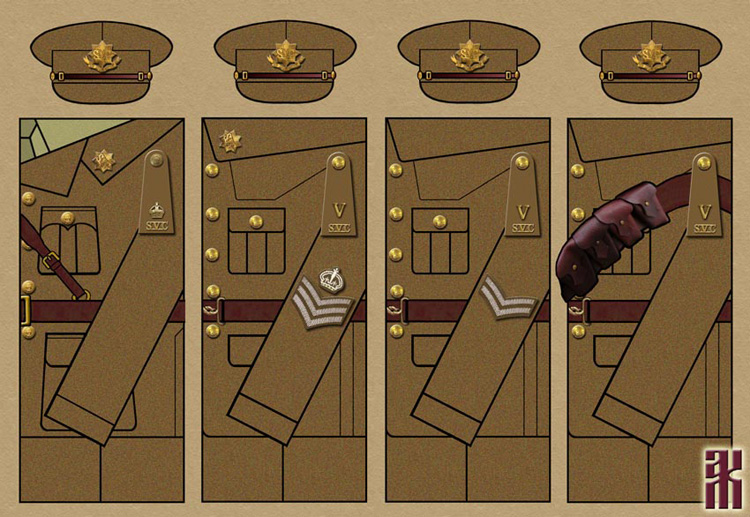
Uniforms of the Russian Detachment of the Shanghai Volunteer Corps, 1927-1929
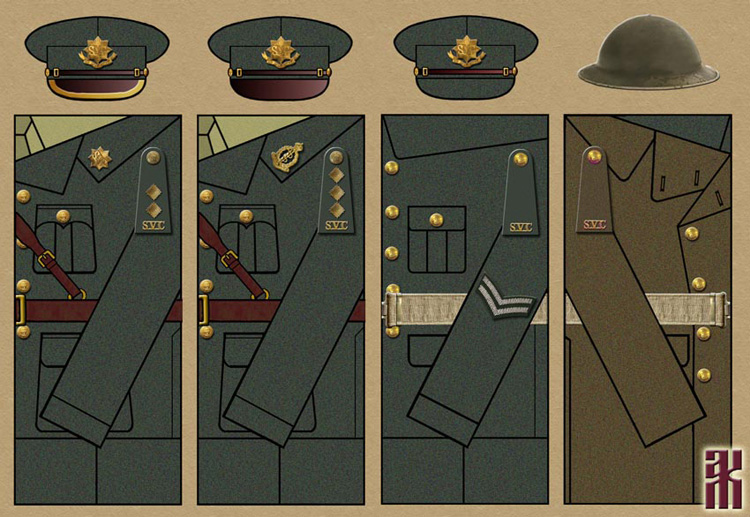
Uniforms of the Russian Detachment of the Shanghai Volunteer Corps, 1929-1936
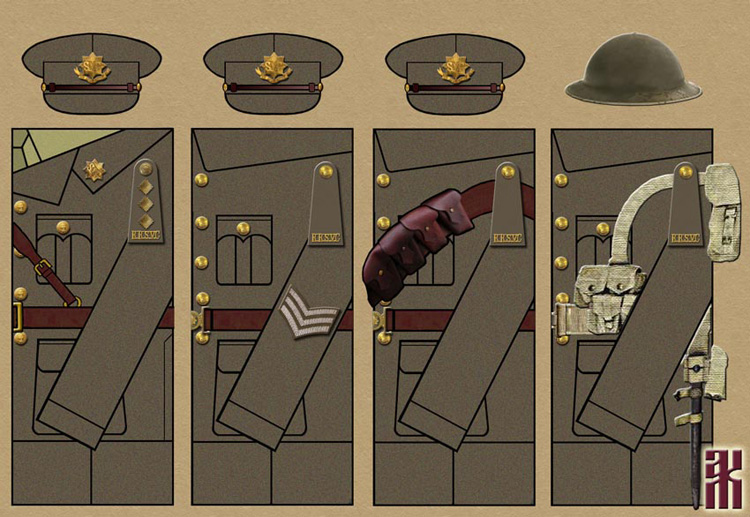
Uniforms of the Russian Detachment of the Shanghai Volunteer Corps, 1936-1940
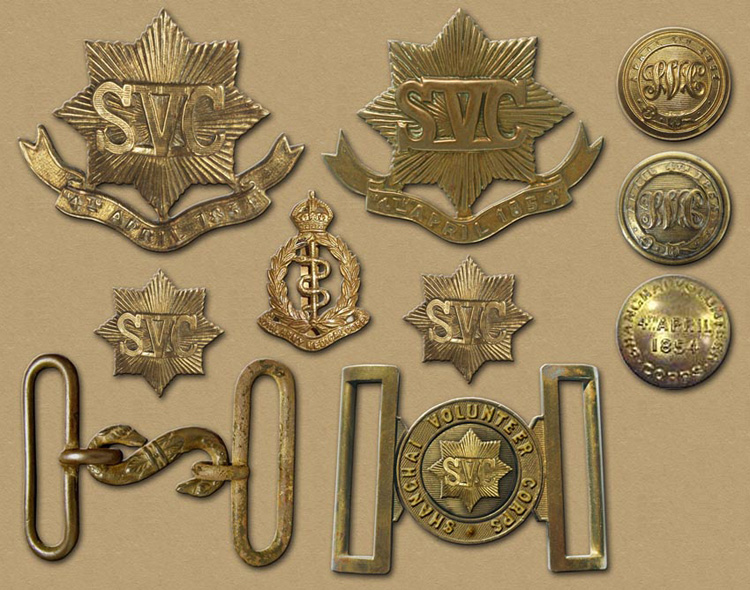
Uniform details of the Russian Detachment of the Shanghai Volunteer Corps:
Top left – variations of the cockade for headgear;
centre left – lapel badges for officers and sergeant-majors and either side of a lapel badge for the medical service (Royal Medical Corps);
bottom – belt buckles for lower ranks before 1929 (right) and after 1929 (left);
top right – samples of officer (top and middle) and soldier buttons (bottom).
24 March 1938
By regimental order, the regiment's officers wore "R.P.S.V.C." insignia on their shoulder-boards.
Krasnousov, p.309.
Regiment order No. 266, 2, dated 23 September 1938:
At the beginning of this year, the Municipal Council decided to award medals to all personnel of the Shanghai Volunteer Corps, Fire Brigade and Police for services rendered to the Council during the period of hostilities between the Chinese and Japanese in Shanghai from 12 August to 12 November 1937. All officers and volunteers of all ranks who were permanently or temporarily serving in the regiment (Battalion C) under my command during the period from 12 August to 12 November 1937 shall be awarded a medal by the Municipal Council with the inscription: "For services rendered from 12 August to 12 November 1937". Basis: Corps Order No.s 26 and 40 of 26 March 1938.
Krasnousov, p.310.
Transfer to Police
24 November 1940. In recognition of their services to the international settlement, the Municipal Council retained the ranks and external distinctions assigned to the officers of the regiment. ... On 15 January 1941, by order of the Shanghai Volunteer Corps, the regiment left the corps and was placed at the disposal of the chief of the municipal police. ... The next day, 16 January 1941, the regiment was renamed the "Russian Auxiliary Detachment of the Shanghai Municipal Police" ... Soon the unit received new "blue" police uniforms with silver lettering on the shoulder-boards reading "R.A.D.S.M.P." The officers were given police uniforms with the number of stars they had in the corps: the regimental commander received a uniform of a senior assistant chief of police, the captains received the uniform of assistant chiefs of police, and the lieutenants received the uniforms of police superintendents. The uniform was excellent, tailor-made from high-quality material. The officers' peaked caps, trimmed with wide silver braid (according to rank), were adorned with a large, solid silver enamel star with the coat of arms of a military model. The short lacquered stick was replaced by a police baton of the standard police model, which served as their "cold weapon".
Krasnousov, pp. 319-321.
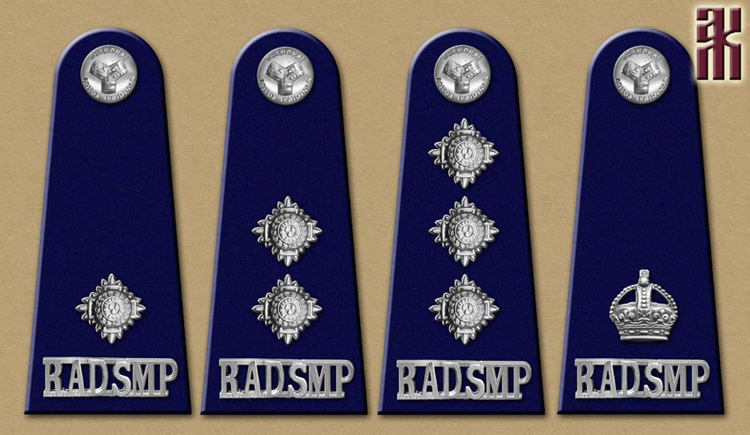
Rank markings of the Russian Auxiliary Detachment of the Shanghai Municipal Police:
1 – senior assistant to the chief of police; 2 – assistant to the chief of police;
3 and 4 – police superintendent
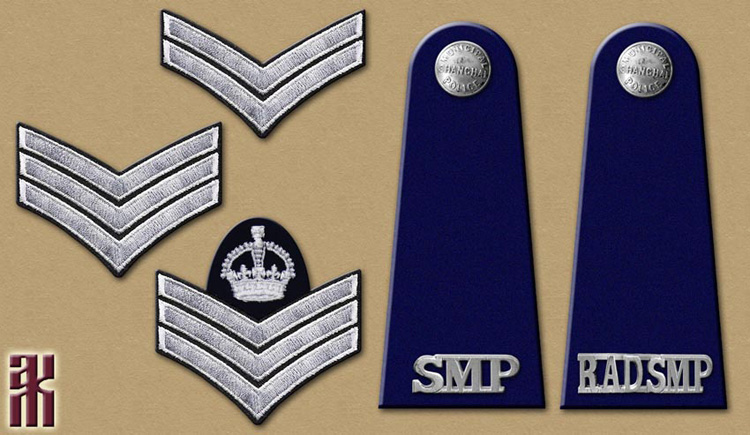
Rank markings of the Russian Auxiliary Detachment of the Shanghai Municipal Police:
Chevrons worn on the right sleeve: 1 – constable, 2 – sergeant, 3 – senior sergeant;
4 and 5 – shoulder-boards of NCOs for Shanghai Municipal Police, then the Russian Auxiliary Detachment of the Shanghai Municipal Police
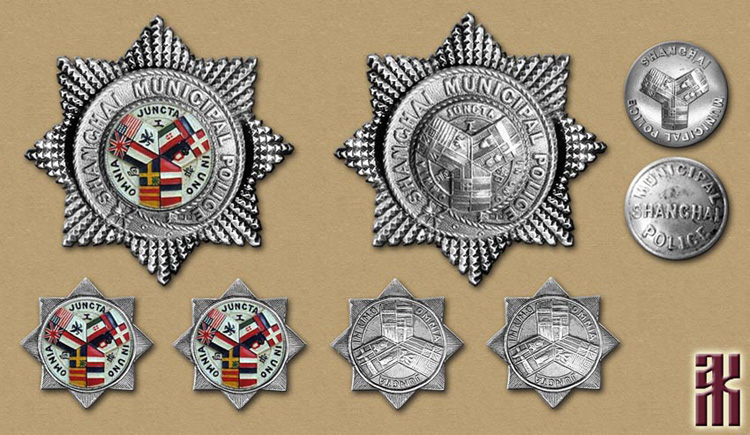
Insignia details of the RADSMP:
1 – officer's cockade and shoulder-board insignia, inlaid with enamel;
2 – cockade and shoulder-board insignia for NCOs;
3 – officer's and NCOs buttons.
Japanese occupation of Shanghai
The ranks and titles remained the same, as did the uniform of the Shanghai Municipal Police. ... Cut off from the rest of the world by the war, Shanghai began to suffer from a shortage of virtually everything. The shortage was particularly acute in clothing and footwear, for which there was no replacement. Shanghai could provide cotton, but broadcloth and rubber came from abroad, with which there was no connection after the Japanese military failures at sea. Therefore, the commander of the detachment paid special attention to the careful storage and sensible wearing of government uniforms, which were no longer sewn new for each new recruit, but were "inherited" from a detachment officer who left the service or obtained from the police warehouse of old uniforms.
Krasnousov, p.353.
A special arm-band (white with red characters embroidered on it) gave us, the officers of the detachment, the right to move around the streets even during raids.
Krasnousov, pp.359-360.
Establishment of the government of the Republic of China, 1945
The detachment received a new cockade for their caps: a gilded tin with a blue Kuomintang star on a white background in the centre, surrounded by ears of rice. From the police warehouse, they received Chinese police uniforms, which were already quite worn.
Krasnousov, p.364.
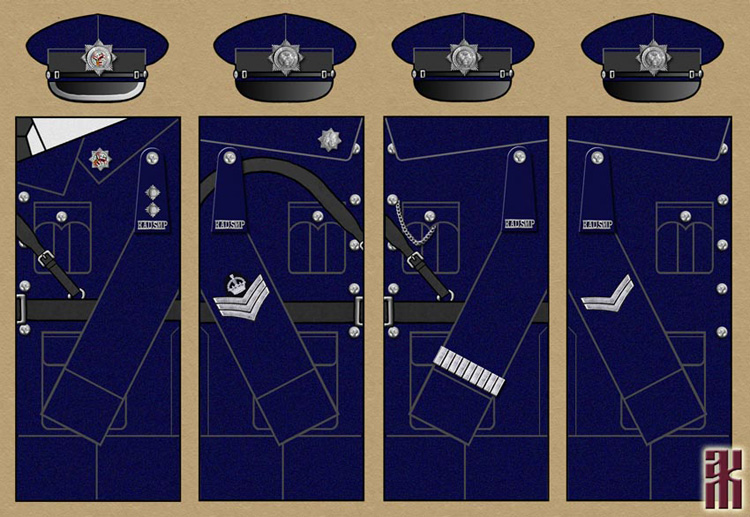
Uniforms of the Russian auxiliary detachment of the Shanghai Municipal Police, 1940-1945
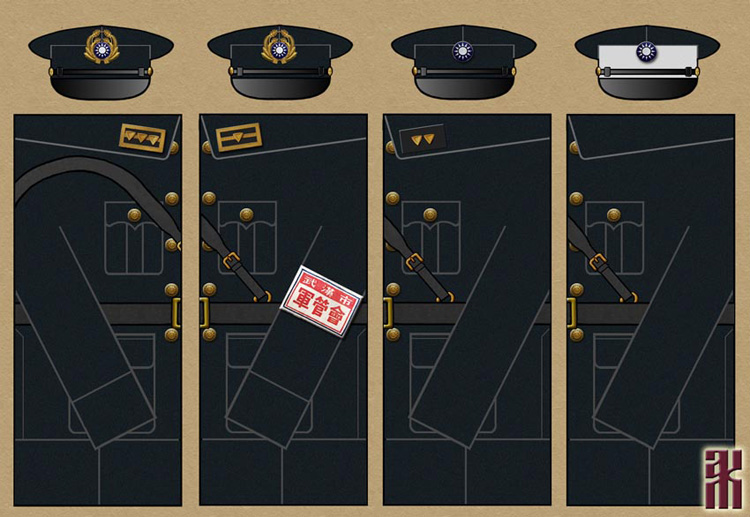
Uniform of Russian officers of the Shanghai Police of the Republic of China (Kuomintang)
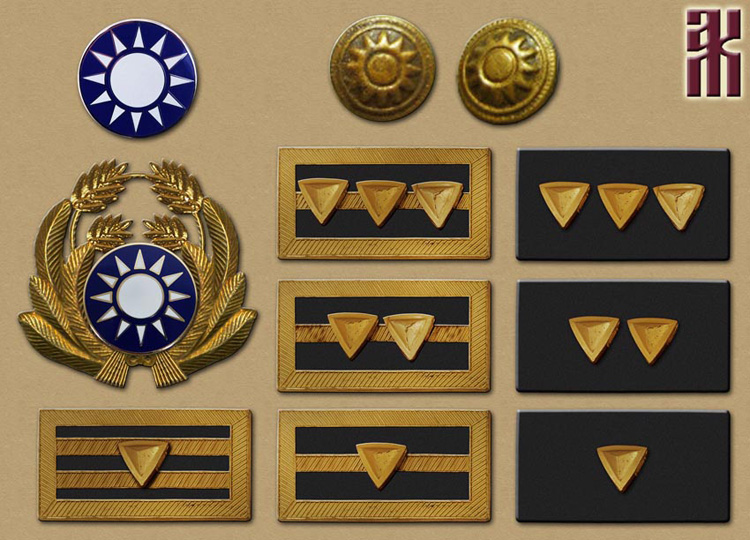
Insignia and rank markings of police officers in the Republic of China (Kuomintang):
Top – cockades of privates and junior officers; below – cockade of senior officers.
The Russian regiment wore the uniform of the regular British Army, except that the cockade on the cap was that of the volunteer corps.
Alekseev, E. in "The Shanghai Russian Regiment // White Emigration in China and Mongolia", Moscow, 2005, p.374.
On 28 March 1932, Order No. 88 of the regiment announced:
In accordance with a recent decision by the Municipal Council of the International Settlement, the Commander of the Corps will present the regiment entrusted to me with a banner. The banner is the national flag of the Imperial Russian State, as a sign of the unit's nationality, with municipal stencils embroidered on both sides of it, which are a sign of the authority to which the regiment is subordinate. The ceremony of attaching the banner to the pole will take place in the Corps' gymnasium at 12:15 p.m. on Friday 1 April. The ceremony will be attended by members of the Municipal Council, the commander of the British expeditionary forces in Shanghai, the Corps Commander with his staff officers, the commanders of the Corps units, the commanders of the British military units in Shanghai, and representatives of the Russian colony, both military and civilian. From the regiment entrusted to me, the following are to attend the ceremony: all officers (including doctors), the standard-bearer and a squad from each company (from four companies) made up of the sergeant-major, a sergeant and a volunteer. At 12:15 p.m. on Sunday 3 April, at Reis-Korsa (in rainy weather, in the Drill Hall) the consecration of the banner and the ceremony of its presentation to the regiment will take place.
At 12:15 p.m. on 1 April the banner was nailed to the pole in the gymnasium of the building. A large table covered with the municipal flag was placed in the middle of the hall. Three steps in front of the table stood four sergeant-majors, four sergeants and four volunteers (one from each company), lined up in a row facing the table. The flag was brought in by Corporal Lenkov, accompanied by Lieutenant Gapanovich, and laid out on the table with the cloth unfolded. Here, the cloth was finally fitted to the pole and attached with 80 nails hammered in one-third of the way.
When all the guests of honour had arrived in the corps' officers' mess (a room adjacent to the gymnasium), the ceremony of nailing the banner (the final hammering of the nails) began. The first nail was offered to the chairman of the municipal council, General Macnaghten, and then to all the others present, in order of seniority or position. Each of those present, after hammering in a nail, signed a special sheet of paper on the table near the banner.
The ceremony of consecration and presentation of the banner to the regiment was exceptionally beautiful. Nearly five hundred men in beautifully ironed uniforms, with leather and brass fittings polished to a shine, lined up in a straight line, with a full (approximately forty people) orchestra of the regular English battalion on their right flank, lined up in a broad front with rows spaced three steps apart, presented a majestic, unforgettable sight!
The church service and the beautiful sermon by Archpriest Sergius Borodin gave this ceremony even greater significance and united the regiment and the spectators present at the parade into a single whole.
"Regiment, under the banner, attention!" was the command of the assistant regimental commander, Captain Ivanov, who was in charge of the parade. The command was clearly heard, and the two rows, bristling with bayonets, froze, greeting "their" well-deserved banner. The English battalion's orchestra played a "slow march", and Lieutenant Gapanovich led the flag, carried by the flag bearer, Corporal Lenkov, with two assistant officers along the front and between the regiment's ranks.
This part of the ceremony turned out to be a little drawn out, since our Russian slow march (or rather, funeral march) has nothing in common with the English "slow march" in terms of either meaning or execution. Their movement is performed at a normal pace, only at a slower tempo, in our march, the pace is not only slowed down, but also reduced in size, slowing the movement to almost half the usual speed.
The standard-bearer carried the flag in front of the regiment. "Ceremonial march, company by company", Captain Ivanov's command rang out, and the regiment reorganised into a company column, then began to move to the bravura sounds of the march "Under the Double-Headed Eagle", specially chosen for the occasion by the conductor of the English orchestra. With a straight line of bayonets and heavy, distinct steps, company after company, the regiment marched past the corps commander and all the generals, "at attention" as they approached the salute site. A loud "Hurrah!" and applause from the spectators accompanied each company, which, after passing the salute, reorganised into a platoon column on the march, then stretched out into a column of two rows and headed for the exit from Reis-Korsa, carrying its banner at the head. The entire Shanghai press, both English and Chinese, wrote at length and with great admiration about this ceremony, noting the regiment's achievements and its brilliant training.
Alekseev, pp.235-237.
Home — State Symbols — Flags — Uniforms — Badges & Medals — Money — Other
Pygmy Wars Notes
The original for this page is at kolchakiya.ru/uniformology/China_emigrant_formations.htm.
The original page had some material on awards and medals, but I am not doing them at this time.
Discussion on the translation choices I have made can be found here.