
Uniforms of General Bakich's Orenburg Corps, 1921
Reconstruction by A. Karevskiy
On 1 September (19 August) 1921 Bakich wrote in an order to the division commanders of his corps before leaving Shara-Sume: "... In view of the shortage of command personnel, I authorise Red Army command personnel who have defected to our side to take command positions, if they so desire, no higher than company or battalion commanders, under the responsibility of their immediate superiors. Keep in mind that many of those who have defected to us from the Red Army have proven themselves to be quite reliable commanders, even those who graduated from Red military schools. Explain to those who have surrendered that we wear shoulder-boards not to demand salutes, but to distinguish our side, and that it is not uncommon in our ranks to see a colonel's shoulder-boards with one, two, or three stripes, which means that the colonel serves almost as a private, while a former ploughman commands him. From now on, when appointing command positions we must be guided not by rank, but by combat ability and the ability to deal with the men.
Ganin, A. V. in "A Montenegrin in Russian service: General Bakich", Moscow, 2004, pp.158-159.
Bakich sent some of the Orenburgers further east: they descended to the Khalka plains from the Altai Mountains. Apparently Ungern's emissaries appeared to them, but the negotiations led to nothing. During interrogation he confirmed that Bakich did not follow his commands. The issue here was not only the old general's ambition, although that was undoubtedly a factor: but with his uncompromising monarchism, Ungern was too odious a figure for Bakich. He had tried to use the pure Socialist Revolutionary slogans that stirred up the peasantry, for which people were shot without trial in Urga. The Asiatic Division set out on its last campaign under a banner embroidered with the name of Michael II, while a red flag flew over the headquarters of the Orenburg Army in Shara-Sume. Only in its upper corner, near the pole, was a tiny tricolor rectangle sewn on. They even wanted to abolish shoulder-boards, but the officers were outraged. Bakich had to justify himself: "We wear shoulder-boards not to demand salutes, but to distinguish our side." There is a certain ingratiation in his explanations, calculated for the peasant rebels: "it is not uncommon in our ranks to see a colonel's shoulder-boards with one, two, or three stripes, which means that the colonel serves almost as a private, while a former ploughman commands him". Ungern might well have forced the colonel to serve not only as a private, but also as a shepherd, but the phrase "former ploughman" was unacceptable to him.
Yuzhefovich, L. A. in "The Autocrat of the Desert (The Fate of Baron R.F. Ungern-Shternberg)", Moscow, 1993, p.170.
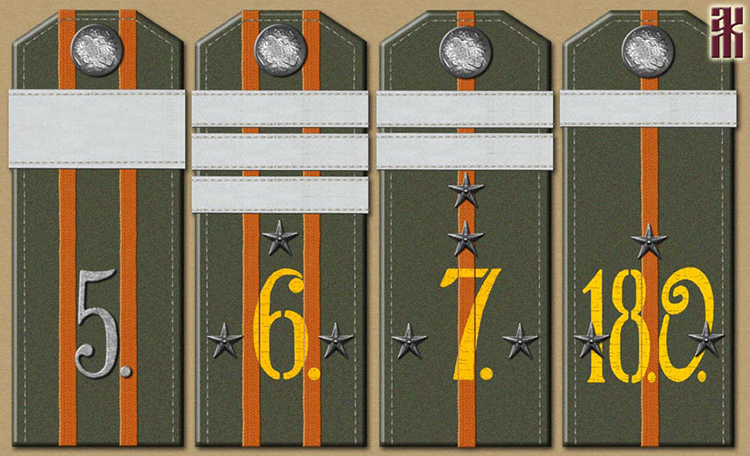
Reconstruction of the shoulder-boards of NCOs of the Orenburg Corps
1 – colonel serving as sergeant-major, 2nd Syzran Rifle Division:
2 – lieutenant-colonel serving as sergeant in the 2nd Syzran Rifle Division;
3 – staff-captain serving as corporal in the 2nd Syzran Rifle Division;
4 – lieutenant serving as lance-corporal in the 5th Orenburg Rifle Division
The stripes are shown as being made not of braid, but of simple white fabric with turned and stitched edges.
Home — State Symbols — Flags — Uniforms — Badges & Medals — Money — Other
Pygmy Wars Notes
The original for this page is at kolchakiya.ru/uniformology/Bakich_corp.htm.
History of the Bakich Corps
Bakich led his units south-east after the collapse of the Orenburg Cossacks, rather than eastwards to Transbaikalia. After a brief stay in the Semirech'e with Ataman Annenkov they moved into refuge in China. After a while the Soviets started to apply pressure on the local Chinese and Bakich was forced to retreat to Mongolia. The Reds chased him and his corps was destroyed.
The books by Serebrennikov and Ganin give more details, here.