
Flags of Anti-Bolshevik States in Eastern Russia (1918-1925)
based on memoirs and historiography
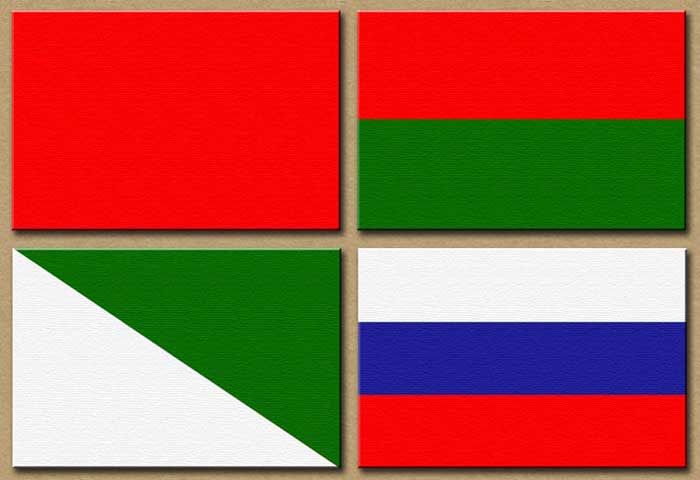
Anti-Bolshevik government flags: 1 – KOMUCH; 2 – Provisional Urals Regional Government;
3 – Provisional Siberian Government; 4 – Provisional All-Russian Government
Committee of Members of the Constituent Assembly (KOMUCH)
Samara, June 1918
Tsarist flags were hung on some buildings.
Popov, F. G. in "1918 in Samara Province: Chronicle of Events", Kuibyshev, 1972. p. 133.
We walked down Dvoryanskaya Street. Tsarist flags were flying there, and the whole street was blocked with bourgeoisie"
Gonya in "Constituentia: from the memoirs of a worker // Train of Death", Kuibyshev, 1957. p. 19.
The official ... banner of KOMUCH became a red flag with the inscription: "Power to the people – power to the Constituent Assembly".
Maisky, I. in "Democratic Counter-Revolution", Moscow-Petrograd, 1923, p. 60.
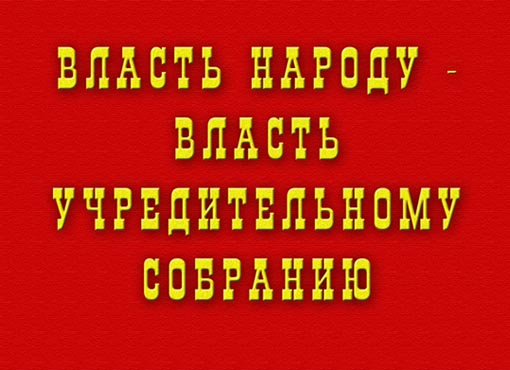
On its first day in power, the KOMUCH raised a red flag above its building. Most of the population reacted to this act with bewilderment, accusing the KOMUCH of Bolshevism and similar crimes. Some even greeted the appearance of the red flag with rude shouts such as "Down with that red rag!"
But the Committee showed great persistence in this matter as well. KOMUCH believed that what the Bolsheviks had done by dispersing the Constituent Assembly was, in essence, a counter-revolution. KOMUCH's struggle was intending to restore the people's freedoms, and so was essentially a revolutionary struggle. The symbol of the revolution is the red banner. That is why we raised the red banner on our buildings. By this act we wanted to emphasise to both our friends and our enemies the nature of our power and our activities, and the nature of our entire future revolution.
Klimushkin, P. D. in "The Struggle for Democracy on the Volga: The Civil War on the Volga in 1918", Prague, 1928, p. 48.
Samara, July 1918
They fought under the red flag. "The red banner raised by KOMUCH at the time of the uprising," wrote its chairman Volskiy in the Samara newspaper Vestnik Komuch, "is a symbol of the struggle of all the oppressed against the Bolsheviks and Germans ... As for Russia's national flag, the Committee did not consider it, and leaves its decision to the Constituent Assembly."
Rybnikov, V. V. and Slobodin V. P. in "The White Movement during the Civil War in Russia: essence, evolution and some results", Moscow, 1993. p. 43.
Many of the KOMUCH's actions caused discontent and even resentment among the volunteers of the newly formed detachments, among the population of the Volga provinces and, especially, among the officers. The raising of the red flag over the KOMUCH building indicated that the Socialist Revolutionaries who had taken up residence there wanted to destroy the Bolsheviks only in order to continue the work of "deepening the revolution" according to their old designs.
Yefimov, A. G. in "In Memory of Admiral Kolchak // Military Reality No. 66", Paris, 1964, p. 6.
Samara, August 1918
The following episode is highly indicative of the situation. A red flag flew above the Committee building. One night in the second half of August, a group of Siberian officers arrived in Samara. Wandering around the city, they came across the Committee building and were surprised to see a red banner flying above their heads. Calling the commandant on duty, the officers asked him in a very insolent tone:
"What is that red rag hanging over the building?"
The commandant tried to reason with them, but in vain. An argument ensued. The commandant wanted to arrest the officers, but instead he himself was arrested by them. The incident attracted the attention of other people who were in the Committee building at the time. The phones started ringing, the Committee's administrator arrived and, upon learning what was going on, went to Galkin with a proposal to immediately arrest the Siberian officers. However, Galkin stated:
"I myself have said many times that this rag must be removed."
Of course, Galkin took no real measures to rein in the Siberian officers. Upon learning of this whole story, the members of the Committee became very angry. At a meeting on 18 August, the Head of the Military Department was reprimanded for his weakness and indecisiveness during the incident. Galkin flew into a rage and threatened to resign. This had the desired effect.
Maisky, I. in "The Democratic Counter-Revolution", Moscow-Petrograd, 1923, pp. 156-157.
Simbrisk, July 1918
An officer, a worker, an engineer, a peasant, a technician, and a merchant stood side by side. They held the national flag tightly in their hands.
Vyrypaev, V. O. in "The Kappelevtsy // Vestnik Pervopokhodnika No. 3", Los Angeles, 1964, p. 12.
Kazan, August 1918
By morning it was all over, and Russian national flags flew defiantly and proudly in the wind under the clear sky above the city.
Fedorovich, A. A. in "General Kappel", Melbourne, 1967, p. 36.
At that moment, Colonel Stepanov drove up in a car with the national flag. ... Getting out of the car, Colonel Stepanov thanked us for such a successful operation and asked: "Where is your commander?"
Saluting, I replied that our commander was seriously wounded and pointed to Lieutenant Vatygin, who was lying on the ground.
Meibom, F. F. in "The Thorny Path // Pervopokhodnik No. 24" Los Angeles, 1975, p. 22.
Samara district, July 1918
The next morning, two cadets killed on the Milutin in the battle near Batraki were buried. The coffins were covered with St. George flags – the flags of the People's Army. Actually the People's Army ... introduced St. George ribbons instead of cockades on hats, and Midshipman M. initially raised a black and yellow flag on the ships, in the form of a large ribbon, instead of the St. Andrew's flag, following the example of Kappel's army.
Lieutenant M. in "The War on the Volga in 1918: From the Shores of America // Jubilee Historical Collection of the Society of Russian Naval Officers in America: 1923-1938", New York, 1939, p. 291.
In August, after the capture of Kazan, St. Andrew's flags were raised on the ships of the flotilla instead of the black and yellow St. George flag, as had been introduced by the People's Army.
Kadesnikov, N. Z. in "A Brief Essay on the White Struggle under the St. Andrew's Flag on Land, Seas, Lakes and Rivers of Russia in 1917-1922." St. Petersburg, 1992, p. 60.
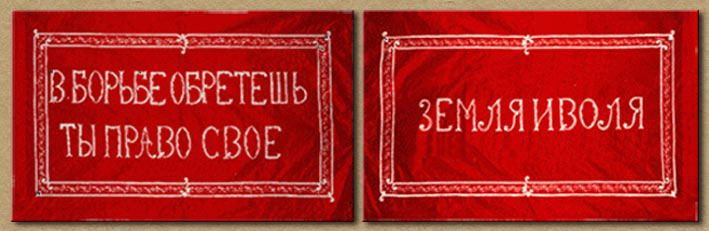
Party banner of one of the local branches of the Socialist Revolutionary Party
Image from vexillographia.ru/russia
2. Provisional Siberian Government
Minutes No. 27 of the meeting of the Administrative Council of the Provisional Siberian Government on 10 October 1918.
2. Verbal presentation by the Minister of Internal Affairs on the arrangement of colours on the flag of Siberia.
The flag of Siberia shall be considered the state flag, consisting of two panels of white and green colours, joined diagonally to form a rectangle. The green colour runs along the pole and is located below the white colour.
RGVA F.39597Op.1 D.3. L.184 ob.
Tomsk, August 1917
The combination of white and green were the traditional colours of the Siberian regionalist movement. It followed that the Conference of Public Organisations of Siberia, convened by regionalists on 5 August 1917, after hearing the report of delegate P. A. Kazantsev, unanimously approved the following description of the Siberian flag: "The Siberian flag is to be a combination of two colours: white and green. The white represents the snow of Siberia, the green represents the Siberian taiga. The flag is rectangular in shape, divided into two parts by a diagonal line connecting the upper left corner with the lower right corner, with the upper part being green and the lower part being white."
Zhuravlev V. V. in "State Symbols of White Siberia: History of White Siberia // Abstracts of a scientific conference", Kemerovo, 1995, p.12.
After the vote (on the question of the need for autonomy for Siberia), conference member P. A. Kazantsev unfurled, to the happy applause of the conference members, a white and green banner with the inscription "Long live autonomous Siberia," while explaining the history of the white and green colours of Siberia.
Afterwards the white and green banner adorned the meeting rooms of all Siberian congresses, the Siberian Regional Duma and government institutions. The First Siberian Army had a white and green patch on its cap or sleeve as its distinctive mark.
Yakushev, I. A. in "The February Revolution and the Siberian Regional Congresses // Free Siberia Vol. 2", Prague, 1927, p. 23.
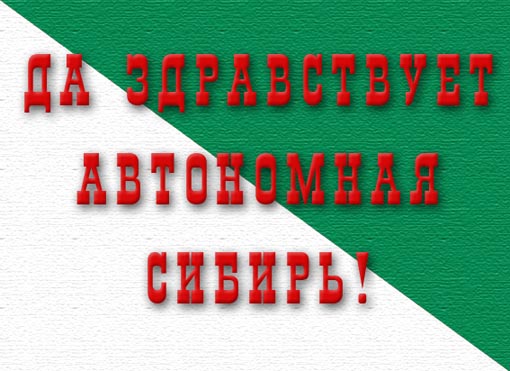
The extraordinary Siberian Regional Congress, which convened in December 1917, proclaimed the creation of an "autonomous regional government" in Siberia and confirmed the resolution of the Conference of Public Organisations on the flag of Siberia.
After power passed to the Soviets, most of the underground anti-Bolshevik military and political organisations that emerged in Siberia acted on behalf of the Siberian government that had been elected on 28 January 1918. Therefore when Siberian rebels rose up against the Bolsheviks in May-June 1918, they fought under the white and green flag. The same flag was raised over the buildings of the new authorities after the coup. So on 26 May 1918, in a proclamation by members of the West Siberian Commissariat of the Siberian Government, it was announced that "in accordance with the resolution of the extraordinary Siberian Regional Congress, the colours of the flag of autonomous Siberia are established as white and green – the emblem of the snows and forests of Siberia."
The Vladivostok Provisional Government of Autonomous Siberia, which claimed it acted under the central Siberian authority, also recognised the official nature of the white and green flag. Its resolution of 30 July 1918, signed by the Chairman of the Council of Ministers, P. Ya. Derber, and the Acting State Secretary, E. V. Zakharov, stated: "We approve for publication the form of the Siberian flag adopted by the Tomsk Conference of Public Organisations of Siberia on 5 August 1917 (white and green). The all-Russian tricolour flag may also fly alongside the Siberian flag."
Zhuravlev, V. V. in "State Symbols of White Siberia" History of White Siberia // Theses of the scientific conference", Kemerovo, 1995. pp. 12-13.
The "white-green" flag, an emblem of the snows and forests of Siberia, flew proudly and joyfully and was greeted with high hopes and love.
Gins, G. K. in "Siberia, the Allies and Kolchak, Vol. 1" Beijing, 1921, p. 68.
Tomsk, May 1918
On the evening of 29 May the Czechs ... entered the city and were solemnly greeted at the Europa building by an honour guard of Siberian volunteers of around 500 bayonets under the command of Lieutenant-Colonel Pepelyaev. ... Alongside the large white-green banner fluttering near the stocky figure of Pepelyaev, was the white-red banner of free Bohemia.
Kirilov A. A. in "The Siberian Army in the Struggle for Liberation // Free Siberia Vol. 4", Prague, 1928, p. 44.
Petropavlovsk, June 1918
The emblem of snow and forests – the white and green banner flew in Siberia, and it was greeted with hope for a bright future.
Filimonov B. B. in "On the Way to the Urals: The Campaign of the Steppe Regiments: Summer 1918", Shanghai, 1934, p. 29.
Omsk, July 1918
On 1 July 1918 the first decrees of the Siberian government were published in Omsk, marking the beginning of the restoration of the state. The white and green flag that flew at that time became famous, as did the Siberian government.
Gins G. K. in "Siberia, the Allies and Kolchak. Vol. 1", Beijing, 1921, p. 239.
Verkhneudinsk, August 1918
The Siberian troops occupied Verkhneudinsk without a fight. When the Siberian army HQ's train approached the city, orders were given to decorate it with white and green flags.
Kirilov A. A. in "The Siberian Army in the Struggle for Liberation // Free Siberia Vol. 4", Prague, 1928, p. 55.
Chelyabinsk, August 1918
[The 2nd Conference] is where our "triumphal march" ended, and a completely different wind began to blow. Our train passed by silent stations with white and green flags flying.
Maisky, I. in "Democratic Counter-Revolution", Moscow-Petrograd, 1923, pp. 203-204.
Incidentally, both camps tried to impress each other – and the moderate, wavering elements – with the external splendour of their speeches at the conference. The Siberian delegates, led by I. Mikhailov and General Ivanov-Rinov, therefore arrived in Chelyabinsk on a special train, above which flew the white and green flag of Autonomous Siberia. They brought with them a large entourage, with the numerous military uniforms of all the branches of the armed forces standing out brightly.
Maisky, I. in "Democratic Counter-Revolution", Moscow-Petrograd, 1923, p. 202.
Perm, December 1918
Only when the friendly and faithful young Siberian troops marched through the streets of the city, shaded by glorious white and green battle flags, did the population begin to believe in the reality of the miracle of liberation.
Kirilov, A. A. in "The Siberian Army in the Struggle for Liberation // Free Siberia Vol. 4", Prague, 1928, p. 53.
3. Provisional All-Russian Government ("Ufa Directory")
Omsk, October 1918,
Above the building where the governor-general once lived, and where the imperial standard was hung in tsarist days, now flew the white and green banner of the Siberian government.
Maisky, I. in "Democratic Counter-Revolution", Moscow-Petrograd, 1923, p. 301.
I was pleased to see the national flags flying above the railway workshops. The station was also decorated with national flags.
Boldyrev V. G. in "The Directory, Kolchak, the Interventionists: Memoirs", Novnikolaevsk, 1925, p. 65.
The Siberians were asking to keep the name "Siberian" for their troops, as well as to retain the white and green cockade and flag. I agreed to a double cockade and ribbons of their colours on the Russian national flag.
Boldyrev V. G. in "The Directory, Kolchak, the Interventionists: Memoirs", Novonikolaevsk, 1925, p. 81.
Samara area, October 1918
The next morning the "Constituent Assembly" battalion arrived. A thousand fresh fighters, well-equipped and well-clad, replaced General Sakharov's Volga Division. ... We did not like this battalion with its red flags, which we hated, and various revolutionary slogans.
Meibom F. F. in "The Thorny Path // Pervopokhodnik No. 27", Los Angeles, 1975, p. 9.
Chelyabinsk, October 1918
There was a solemn greeting of the delegation at the railway station. An honor guard flew the old tsarist banner. This was apparently established on an ad hoc basis. The issue was extremely delicate at the time.
Boldyrev V. G. in "The Directory, Kolchak, the Interventionists: Memoirs", Novonikolaevsk, 1925, p. 64.
4. Provisional Urals Regional Government
The Provisional Urals Regional Government (PURG) was formed on 13 August 1918 in Ekaterinburg. The chairman of the government was P. Ivanov. In its statement of 19 August, the government declared that "a two-colour flag consisting of two horizontal stripes – bright red at the top and light green at the bottom – shall be the distinctive symbol of the Urals Region."
www.vexillographia.narod.ru
October 1918
The Council of Government approved the two-colour Ural flag, consisting of two equal horizontal stripes – bright red at the top and light green at the bottom.
GASO. F. 1961, op.1, d.57, l.174.
On 18 October I. G. Morozov, the special representative in Alapayevsk, received a telegram informing him of the government's decision to approve his two-coloured flag – one stripe bright red, the other light green – and instructing him to fly the flag over all the administrative buildings in the city and district. With this step the regional government, which was autonomous from the Provisional Siberian Government, sought to emphasise the subordination and control of the Ural factories primarily to the local authorities.
GASO. F. 1951. op. 1. d. 68. l. 45
Dmitriev N. I. and Nemytov O. A. in "White Alapayevsk", Ekaterinburg, 2012, p. 176.
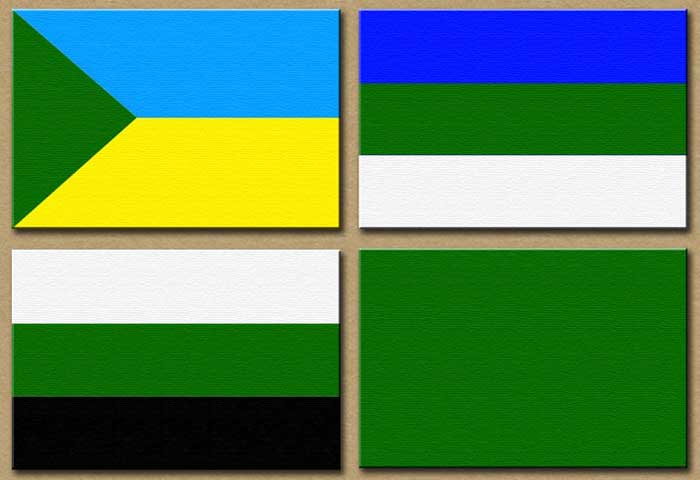
1 – The national flag of the "green wedge" (Ukrainian autonomy in the Far East);
2 – The national flag of the Bashkir Republic; 3 – The national flag of the Tungus Republic;
4 – The "green banner" (used by a number of Muslim states as their national flag, in particular by Kazakh tribes).
5. Tungus Republic (1924-1925)
This appeared during the anti-Soviet uprising of the Tungus people in 1924-1925. After the Provisional Central Tungus National Administration was elected at the congress of the Ayan-Nelkan, Okhotsk-Ayan, and Maimakan Tungus and Yakut peoples in June 1924, on 14 July 1924, the All-Tungus Congress of the Okhotsk Coast and adjacent areas was held in Ayano. The congress adopted a declaration of independence of the Tungus people and the inviolability of their territory with its marine, forest, and mountain wealth and resources. At the same time, the flag of the new state was adopted, consisting of horizontal stripes of equal width in white, green, and black. The white color of the flag symbolized Siberian snow, green symbolized forests and taiga, and black symbolized the earth.
www.vexillographia.ru/russia/index.htm
6. Bashkir Republic (1918-1919)
Established by a decision of the Bashkir National Council and approved by Order No. 4547 of the Military Council on 20 August 1918. It was a rectangular cloth consisting of horizontal stripes of equal width in blue, green, and white. It was also used as a general military banner in units of the Bashkir Corps.
Ildar Shayakhmetov, I. in "On the military-historical reconstruction of the uniforms and symbols of the Bashkir troops of 1917-1919 // Vatandash", Ufa, 2007. www.vatandash.ru
Taimasov R. in "The Bashkir Corps: Fiction and Reality // Vatandash No. 8", Ufa, 2000, pp. 114-115.
7. The "Green Wedge" (1918-1922)
The Green Wedge is the historical Ukrainian name for the southern territory of the Far East (in 1918, it was interpreted as the territory from Lake Baikal to the Bering Strait).
The first attempts to formalise Ukrainian state national autonomy in the Far East were made after the February Revolution. On 11 June 1917 (old calendar) the First All-Ukrainian Congress of the Far East was held in Nikolsk-Ussuriysk. The Far Eastern Regional Council was formed there, and ten district councils appeared locally. Executive power was transferred to the Regional Secretariat.
The Ukrainian movement, separatist in nature, was hostile to the authority of the Supreme Ruler of Russia, A. V. Kolchak, although it did not enter into open confrontation with him. It was only on 11 July 1920 that Ataman G. M. Semenov, in accordance with a decree of 4 January 1920 which gave him "full military and civil authority throughout the entire territory of the Eastern Russian Territories", recognised the right of the Ukrainians of the Green Wedge to national self-determination within the framework of a unified Far Eastern state of Ukrainians, Cossacks, and Buryats, with each people being granted national-territorial autonomy. The Ukrainians were given full local authority, which was further confirmed by a decree by Semenov on 31 October 1920, which also mentioned the need to create a unified Far Eastern peasant-Cossack national committee (government), which would hold all power in the Far East.
The national flag of the Green Wedge was based on the flag of the Czechoslovak Republic, with the color scheme of the traditional Ukrainian flag. Green represented the taiga, blue represented the sky and sea, and yellow represented the wheat fields.
"Daleki Skid", Harbin, 1931
ru.wikipedia.org/wiki/Зелëный_Клин
www.zn.ua/3000/3150/23711/
8. Flag of the Orenburg Host Government
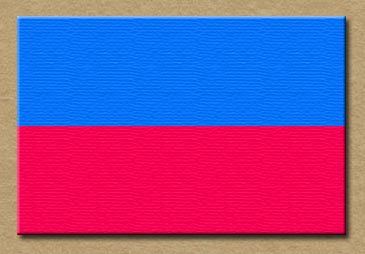
Flag of the Orenburg Host as reconstructed by Professor V. Trembitskiy
(the red is halfway between scarlet and raspberry)
Some vexillological publications mention a version of the flag of the "Orenburg host" during the civil war, consisting of horizontal blue and red stripes. We have not yet been able to find serious evidence of the real existence of this flag. Although, perhaps, such flags were used among emigrants. Clearly the colors of this alleged flag repeat the colors of the lance pennons of the Orenburg lancer regiments, as well as the colors of the Cossack uniforms of the first half of the 19th century (blue caftan with a red trim, raspberry collar and hat crown).
Lomantsov, V. A. in "Banners of the Orenburg Cossack Army // Bulletin of the Russian Center for Flag Studies and Heraldry, No 12(15)", January 2009, pp.7-8.
Home — State Symbols — Flags — Uniforms — Badges & Medals — Money — Other
Pygmy Wars Notes
The original of this page is at kolchakiya.ru/heraldry/wight_gov_flags.htm.