
Kolchak's Official State Coat of Arms for Russia
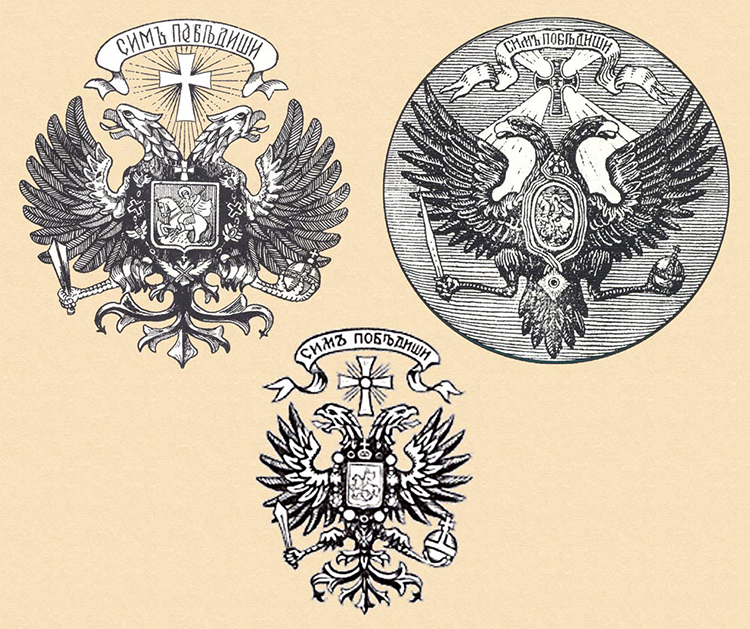
Variants of the Russian State Emblem used in territories under the authority of
Admiral Kolchak, Supreme Ruler of Russia
Note the peculiarities of the second in the upper row, where the chain of the Order of St. Andrew the First-Called has been replaced by a ribbon, star and insignia of the Order of St. George the Victorious, and the French shield shape on the eagle's chest has been replaced by an oval.
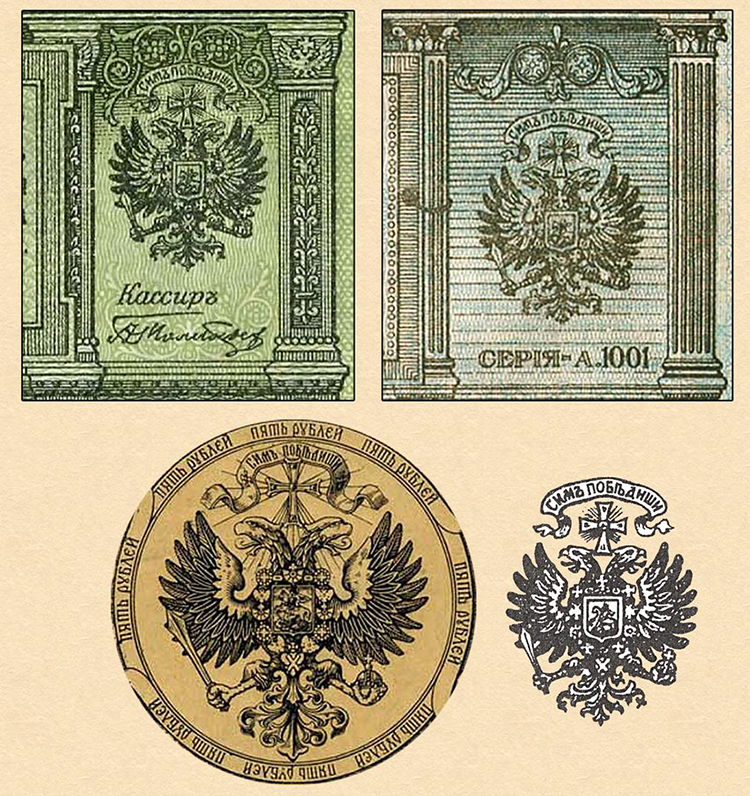
The Russian state coat of arms, officially approved by the Supreme Ruler, was placed on banknotes in circulation in eastern Russia.
At the top is the state coat of arms that appeared on banknotes issued in November 1918 with denominations of 3 roubles (green) and 300 roubles (blue), as well as their black-and-white outline.
At the bottom left is the state coat of arms featured on the 1919 draft design for a 5-ruble banknote, which was never issued.
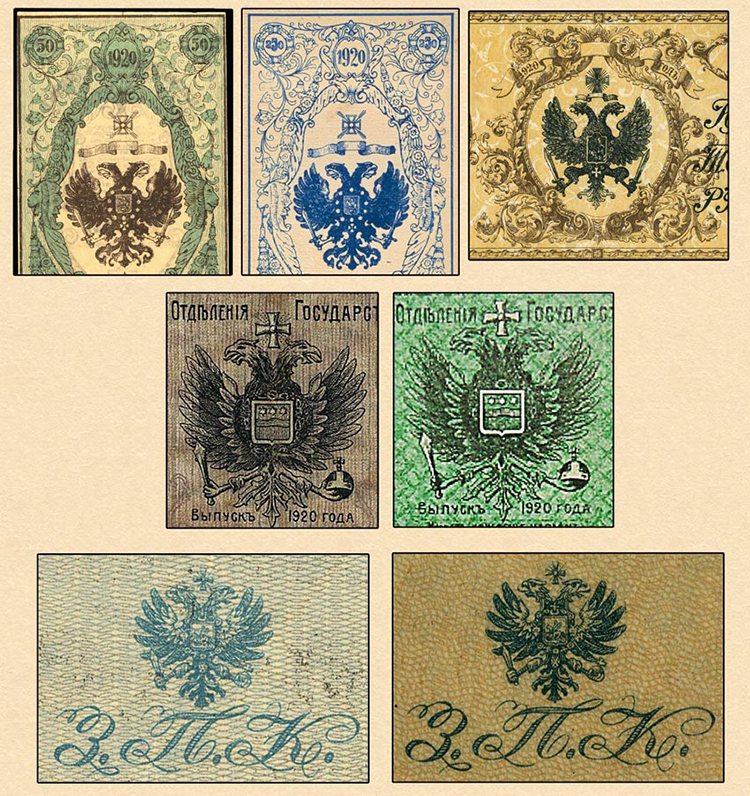
The state emblem of Russia, officially approved by the Supreme Ruler, was placed on banknotes in circulation in Eastern Russia.
Above are the reverse sides of 250-, 50- and 5000-ruble treasury notes of the Government of the Russian Eastern Frontier (issued in 1920 on behalf of the Siberian Provisional Government). The sceptre in the eagle's left talon has been replaced by a sword, so that the eagle holds two swords in its talons.
In the middle is an example of the use of the state coat of arms as a regional coat of arms – the front sides of the 500- and 1000-ruble banknotes of the Blagoveshchensk branch of the State Bank, issued in 1920 (with the coat of arms depicting St. George the Victorious replaced on the eagle's chest with the regional coat of arms).
At the bottom are the reverse sides of 1- and 5-kopeck (gold) coins issued by the government of the Amur Land District in 1921 in Vladivostok. Despite the Priamursky Zemsky Sobor's recognition of the Romanov dynasty's rights to the throne and its proclamation of a policy of restoring the monarchy in Russia, the coins issued continued to bear the state coat of arms approved by the Supreme Ruler.
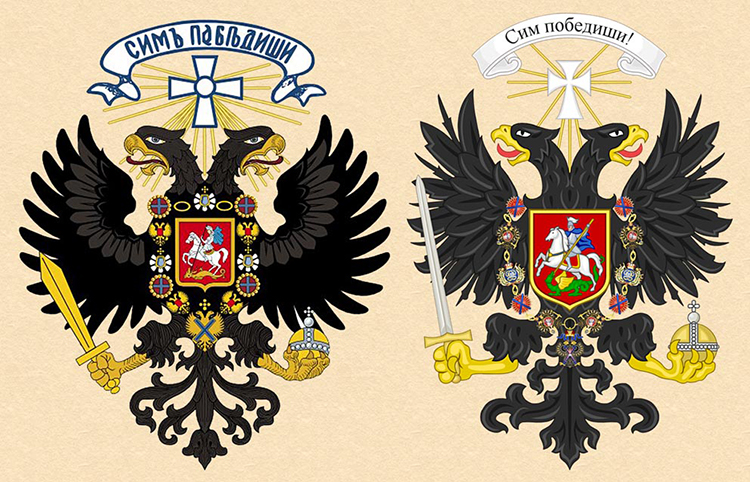
Contemporary reconstructions in the colours of the Russian national emblem
officially approved by the Supreme Ruler
In the words of others
The Lord God Almighty, whom many of us forgot during the years of great trials, gives us our obligations and duty to the Motherland and to bring about its rebirth, happiness and freedom with out labour" (such unconventional and sincere words!), clearly testify to his faith. The dispatch of "preaching detachments" to the front brings to mind the the Commander of the Black Sea Fleet's opinion on the importance of religious education during wartime.
Let us not forget the state symbols adopted under Admiral Kolchak. While the tradition of performing the 18th-century hymn "How Glorious is Our Lord in Zion" as the anthem already existed, a special competition was announced to develop a new coat of arms (based on the traditional image of a double-headed eagle). According to its terms: "instead of the Tsarist era emblems (the crown, sceptre and orb), the coat of arms was to be decorated with emblems characteristic of the new, reviving statehood." However, the adopted version retained not only the orb in the eagle's talon (the sceptre was replaced by a sword), but even the chain of the Order of St. Andrew the First-Called on its chest (which can be seen as not only as a continuation of tradition, but also as a prayerful appeal to the Apostle, the patron saint of Russia). The crown, which disappeared from Kolchak's coat of arms, deserves special mention.
The current government, Admiral Kolchak's government," wrote a front-line newspaper in September 1919, "correctly understanding and appreciating the importance of Orthodoxy in the state-building of Russia, has restored this frivolously and criminally severed connection between church and state. It has humbly and reverently bowed down at the foot of the Cross of the Lord, following on from godless governments devoid of simple state sense." The author of the article continues that recently, in a magazine: "I saw – and was delighted by – an image of the design for Russia's new state coat of arms: the usual mighty double-headed eagle with its wings raised. In its tightly clenched talons it holds a naked sharp sword, as a symbol of power, and a sceptre, as a sign of Russia's sovereign autocratic rights. At the top is a cross, as an obvious symbol of the Orthodoxy of the Russian people. Above the cross, in rays of light, is a brief but eloquent inscription: 'With this thou shalt conquer.' This inscription clearly indicates the recognition of the enormous historical significance of the Cross of Christ and the Orthodox faith in the political construction and destiny of the Russian people and the Russian state. This mighty Imperial Eagle [-] is not the empty-headed, dejected, ragged crow with drooping wings that Kerensky invented for Russia. Such an Eagle can and should be served. We can believe in, love, and be proud of that eagle."
But this interpretation, and even the analogy with Constantine the Great's vision (being shown the symbol of the Cross with the motto "With this you will conquer" before a battle), which is no less evident in Kolchak's coat of arms, pales in comparison with another, even more significant one. As is well known, on the day of the Emperor's abdication, the 'The Sovereign Icon of the Mother of God' was miraculously revealed. On it the Intercessor accepts the lost regalia of God's Anointed One – the crown, sceptre and orb. And in a reciprocal movement, from earth to Heaven, the tumultous country's new coat of arms was crowned with the Cross – the last and only hope. So the earthly regalia were transferred to the icon just as the new coat of arms was topped by the Heavenly Symbol. Although at the time hardly anyone thought about that parallel, it does not become any less eloquent because of that.
Another comparison is just as eloquent. Archimandrite Constantine (Zaitsev), reflecting on the struggle for Russia waged by Kolchak and his associates, referred to words spoken a century earlier: "Show me the ideal that could, with a single word, summon the voice of the people, giving power to its thunderous roar and indomitable action. In other countries that power is now driven by the ideas of progress, civilisation, freedom ... But show their symbols to our people, and they will look at them and ask: is there a sign of the cross or another sacred symbol on them? No? Then they will say, they are not Christian." In 1919, the coat of arms of Russia was literally crowned with the Sign of the Cross, but the fading spirit of the people was no longer able to respond to it...
Kruchinin A.S. in "Admiral Kolchak: Life, Feats, Memory" Moscow, 2010, pp. 302-303.
From mid-1919 the Omsk government began work on designing new types of "Kolchakovka" banknotes, with denominations ranging from 1 to 1,000 roubles. Information in the press about the release of new banknotes, printed on good quality paper with watermarks, appeared as early as May 1919. The decision to issue the banknotes was made by the Ministry of Finance in early June. Like those made in America, these banknotes were intended to be used throughout the country and were named "Russian Renaissance" credit notes. The artist and sculptor I. D. Shadru was commissioned to design them. In addition to the eagle, the Siberian coat of arms, the cross, the motto "With this sign you shalt conquer" [In hoc signo vinces], the "eye of God" and some other elements, the money contained an inscription stating that "the State Bank will exchange credit notes for gold coins without limitation of amount, 1 ruble = 1/15 Imperial, being 17.424 parts of pure gold."
The new money was intended to confirm the legitimacy of Kolchak's authority. The front side of the 1,000-ruble note depicted a coat of arms composed of elements of the Romanov coat of arms. In the upper part of the note was Saint George the Victorious spearing a dragaon, but removed from the usual shield on the eagle's chest. In the centre of the note was a double-headed eagle, illuminated by rays emanating from the "all-seeing eye" hovering in clouds. In the eagle's talons were the regalia of a sword and an orb with a cross. On the eagle's chest (where the Moscow coat of arms had been previously) was now the Siberian coat of arms, of two upright sables with crossed arrows. The eagle's wings had on them the coats of arms of six cities that Kolchak considered his strongholds at that time: Orenburg, Ufa, Chelyabinsk, Omsk, Ekaterinburg and Perm. The eagle was surrounded by a wreath of 26 coats of arms of the regions and provinces of Russia, which were to be conquered in the near future. The emblems on these new banknotes were not fully thought out, and they remained unfinished. The Omsk government did not have time to issue the new notes.
Khodyakov M. V. in "Money of the Revolution and Civil War: Currency Circulation in Russia 1917-1920", Moscow, 2009, pp. 153-154.
The laws of the Provisional Government were restored in the territory under its control. Only in certain cases – namely with regard to the army and relations with the borderlands – were the pre-revolutionary Tsarist laws and regulations restored (in the case of the army, this was simply required). In this way the Whites recognised the legitimacy of the Provisional Government as the successor to the former state power, although they strongly condemned many features of its policy, as mentioned above. This continuity was also expressed in the preservation of certain symbols of the Russian state – again in contrast to the Bolsheviks, who were creating a new state with a different ideology and foundations and therefore fundamentally changed the symbols from the old ones.
The traditional double-headed eagle was inherited as the coat of arms, from which the Provisional Government had removed the symbols of monarchical dignity (the crown and sceptre). Kolchak added the cross of St. Constantine with the motto "With this sign you shalt conquer" instead of the crowns, and placed a sword in the eagle's talons instead of the sceptre. The design of the eagle was also changed: unlike the pre-revolutionary eagle and its modern counterpart, which follows it exactly, the eagle was depicted not with outstretched wings, but with wings spread wide. For comparison, see the photographs of Kolchak at the end of this book: in one of them he is photographed in an admiral's uniform with eagles on his epaulettes before the revolution, and in another from during the Civil War.
Khandorin V. G. in "Admiral Kolchak: Truth and Myths", Tomsk, 2007.
The coat of arms depicted a double-headed eagle. Unlike the imperial one, where the eagle wore a crown and held a sceptre and orb – symbols of imperial power – in its talons, Kolchak's double-headed eagle had the shining Cross of Constantine above its head, with the motto "With this sign you shalt conquer" and held a sword and orb. The coats of arms of the kingdoms and khanates subject to Russia were removed from the wings, but the chain of the Order of St. Andrew the First-Called remained. The sword in the eagle's talons symbolised the struggle against Soviet power, while the Cross of Constantine and the motto symbolised the campaign against Bolshevism. The ultimate goal of Kolchak's government was apparently the restoration of the monarchy, which is why the eagle retained the orb – regalia of monarchical power.
Shikanova I. in "Thoughts, Kerensky, Kolchak... // Rodina No. 10", Moscow, 1990, p. 54.
From the authors
The individual symbols of the coat of arms cited in the works of Khandorin and Shikanova can also be interpreted differently:
The double-headed eagle and St. George the Victorious are symbols of the historical continuity of Russian statehood and a declaration of loyalty to Russia's state traditions.
The sceptre is a symbol of statehood, emphasising the intention to recreate a Great, United and Indivisible Russia.
The sword is a symbol of the state's armed struggle for its existence ("the earthly weapon").
The cross and motto are symbols of a crusade against the godless atheism of Bolshevism, a declaration of intent to win with the help of the Christian faith, placing the confrontation in an apocalyptic context ("the heavenly weapon").
Home — State Symbols — Flags — Uniforms — Badges & Medals — Money — Other
Pygmy Wars Notes
The original of this page is at kolchakiya.ru/heraldry/Kolchaks_State_Emblem.htm.