
The National Anthem of Russia
Material prepared by A. Karevskiy.
How Glorious is Our Lord in Zion
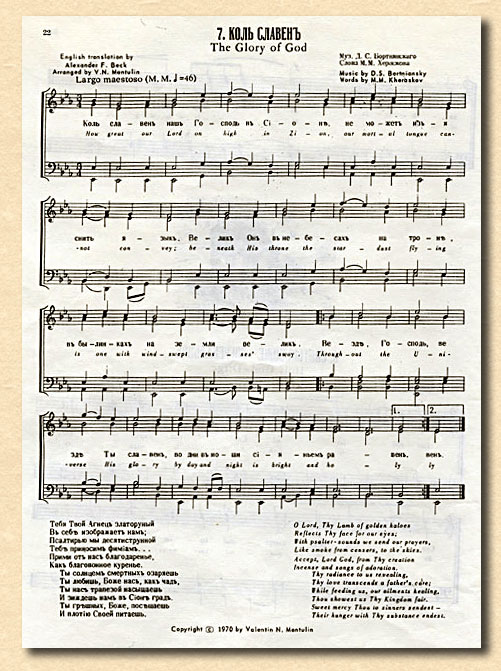

| How glorious is our Lord in Zion, No tongue can express. He is great in Heavens' throne, He is great in the Earth's hymns. Oh Lord, You are Glorious everywhere, At night and by day, You shine the same. |
Your golden-horned lamb represents You to us: With a ten-stringed psaltery We offer You incense. Accept our thanksgiving, Of fragrant smoke. |
|
You illuminate mortals with the sun, You love us, God, as Your children, You feed us with your bounty, And build us a city in Zion. You visit sinners, God, And nourish them with Your flesh. |
O God, May our voices be heard in Your dwelling place, And may our prayers find You, Rising like the morning dew! We will set up an altar for You in our hearts, We will sing and praise You, Lord! |
History of the work's creation
The poem "Kol Slaven" (How Glorious is Our Lord in Zion) was written by poet and playwright Mikhail Matveevich Kheraskov (1733-1807). The music for the hymn, based on folk and church melodies, was composed by Dmitry Stepanovich Bortnyanskiy (1751-1825).
It was first performed on 29 November 1798 in St. Petersburg at a ceremony in the Winter Palace. There – in the presence of the entire Court and the Knights of Malta, who were in Russia – Papal Nuncio Lorenzo Litta placed the crown and other regalia of the Grand Master of the Order of St. John of Jerusalem on Emperor Paul I. From that time on, it effectively served as the national anthem and was performed at all official events.
The anthem was a church chorale with words of prayer. It seems to have been modelled on anthems from pre-Petrine Russia, at a time when liturgical melodies replaced the official national anthem (researchers note its similarity to some of the melodies of the Great Znamensky Chant). Its text does not contain anything about Emperor Paul I himself or his deeds, which emphasises the autocrat's piety and modesty. Instead, the words of the prayer praise God as the mystical foundation of the Russian state.
Even after Emperor Nicholas I approved "Prayers of the Russian People" (or "God Save the Tsar"; music by Alexei Fedorovich Lvov, lyrics by Vasily Andreevich Zhukovsky) as the national anthem in 1833, the song continued to retain its significance as a ceremonial anthem. It was performed during solemn ceremonies associated with Orthodox holidays: during processions at Epiphany, Christmas, and Easter. As the spiritual procession passed soldiers would stand at attention and the orchestra would play Bortnyansky's anthem-prayer.
At the same time, Bortnyansky's "Prayer" became widely used in the army as a prayer during the sunset ritual. This created an uplifting and peaceful mood among the soldiers at the end of the day, which was of great educational importance. It was played after the commands "lances in hand" and "sabres out" during funeral ceremonies when generals, staff and other senior officers who had died in active service were buried. It was also used at the funerals of reserve officers who had been awarded the St. George and the St. George Cross medals. Furthermore, "Kol Slaven" was performed during the ceremony for promoting cadets to officers, in the ritual of "Lowering the Flag with Ceremony" when an artillery volley was fired, and when a bugler played the signal for "prayer, hats off." It was also played after a regiment's parade before the prayer "Our Father."
In the Anti-Bolshevik Camp
The Provisional Government tried to make "Kol Slaven" the official state anthem in 1917. However, that process was only completed during the Civil War. Since that anthem-prayer turned out to be one of the popular symbols of Russian-ness, it retained its role as the national spiritual anthem. This was decisive in its choice as the national anthem of the anti-Bolshevik state, which opposed its enemies' revolutionary ideals of internationalism and atheism with the traditional ideas of faith and nationality.
"Kol Slaven" was performed for the first time in this capacity in eastern Russia on 9 October 1918, during a solemn meeting at the railway station in Omsk of the Provisional All-Russian Government (the so-called "Ufa Directory"). However "La Marseillaise" was performed immediately after it, as a tribute to revolutionary tradition.
The official status of the anthem was later confirmed by a temporary decree of the Supreme Ruler, Admiral Kolchak, published in the Government Gazette on 13 December 1918.
Khandorin V.G. in "Admiral Kolchak: Truth and Myths", Tomsk, 2007
"Kol Slaven" was then performed at all solemn ceremonies. The newspaper Siberian Speech, on 5 March 1919, described the Supreme Ruler's trip to the front: "At a small station, lost among the Ural Mountains, near the Ufa front, Kolchak presented some St. George Crosses. ... In the clear mountain air, the sublime and sad melody of the anthem "How Glorious is Our Lord in Zion" sounded particularly poignant. The commander-in-chief greeted the troops in a quiet but clear voice, and the award ceremony began."
Zyryanov P. N. in "Admiral Kolchak: Supreme Ruler of Russia", Moscow, 2006, p. 455
The Hymn's Ideology
(Based on materials originally published at heraskov.lit-info.ru/review/heraskov/005/401.htm [link now dead.])
The Country
The country lives in humility and faith in God. Everything comes from God: "You illuminate mortals with the sun // You love us, God, as Your children // You feed us with your bounty." This is a conscious refusal to talk about the country itself: the main idea of the anthem is that the singer is right and will prevail because he praised God in time and called him to his side.
The People.
It is not nationality that is important, but faith in God. "With a ten-stringed psaltery // We offer You incense // Accept our thanksgiving // Of fragrant smoke." Christianity is a world religion that does not differentiate between people on the basis of nationality. The White Guards, like the Bolsheviks, sought an ideology that would allow them to unite with the people and lead them. The Bolsheviks found this ideology in the calls for class struggle from the International, while the Whites believed that faith united them with the people, since they could not unite with the people on class grounds.
Power
The source of power is God. He sees and controls everything, he is omnipresent: "He is great in Heavens' throne // He is great in the Earth's hymns." Life under his rule is ideal and sinless. But it is not specified to whom God entrusts power on earth. The anthem was ideal for the White Guards: it was connected to pre-revolutionary Russia, but it never mentioned the emperor or imperial power.
Home — State Symbols — Flags — Uniforms — Badges & Medals — Money — Other
Pygmy Wars Notes
The original of this page is at kolchakiya.ru/heraldry/Kolchaks_hymn.htm.
Other White armies also used this hymn, especially for funeral services.