
The national flag of the Russian state.
Material prepared by A. Karevskiy.
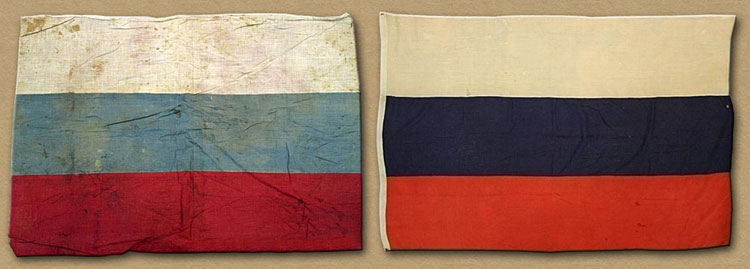 Left: a single piece of fabric measuring 84 by 58 cm. Image from: http://www.antikvariat.ru
Right: a cloth sewn from three pieces, with an attached canvas end strip and brass eyelets along the edges, measuring 180 by 250 cm. Image from: http://www.antikvariat.ru
Note the difference in the blue (azure) and red (scarlet) colours of the flags.
The first stage of the anti-Bolshevik struggle in Eastern Russia (summer to autumn 1918), politically characterised by the phenomenon of the so-called "Democratic Counter-Revolution", was marked by a cautious attitude towards the matter of the state flag. The government of the Committee of Members of the Constituent Assembly ("KOMUCH") used a plain red flag (the symbol of the revolution), while the Provisional Siberian Government used a white over green flag (the flag of Autonomous Siberia). At the same time, at the initiative of representatives of the urban population and the armed forces of these governments, the former tricolour national flag enjoyed a widespread, albeit unofficial, revival.
The first major steps towards its revival as the state flag were taken by the Provisional All-Russian Government (the "Ufa Directorate"). In particular, Russian tricolours (along with Siberian white-and-green) were displayed at the Omsk railway station to welcome members of the government moving from Ufa to Omsk on 9 October 1918. A cockade in the national colours was established for the government's armed forces (until new ones were made the old ones were permitted, but crossed diagonally with a tricolour ribbon).
The process of restoring the white-blue-red flag as the Russian state flag was completed under the Supreme Ruler of Russia, Admiral A.V. Kolchak. Apparently, this was established on an ad hoc basis, as no official orders on this matter have been found to date. At the same time, local and regional symbols began to be gradually withdrawn from use (including the white and green flag of the former Provisional Siberian Government and the red and green flag of the former Provisional Urals Regional Government), which were perceived as separatist and therefore contrary to the officially proclaimed doctrine of a united and indivisible Russia. The former tricolour flag, formerly known as the "People's Flag", perfectly suited the ideological goals of the struggle for the revival of Russia, but at the same time did not evoke undesirable associations with the restoration of the monarchy.
There are several different interpretations of the heraldic colours of the national flag, which could have been equally valid for the Supreme Ruler and his government when it was approved.
| White | Blue | Red | Notes |
|---|---|---|---|
| Nobility and candour | Loyalty, honesty, integrity and chastity | Courage, boldness, generosity and love | Interpretation of the colours of the Flag of the Tsar of Moscow |
| Statehood | The Mother of God, under whose protection Russia stands | Freedom and independence | The 1896 interpretation of Emperor Nicholas II when he approved the Russian national flag |
| Faith / the divine world | Hope / the heavenly world | Love / the physical, carnal world | Christian mystical interpretation, never officially voiced |
| Peace, purity, innocence, perfection | Faith and loyalty, constancy | Energy, strength, blood shed for the Fatherland | Common everyday interpretation |
| Freedom (liberty) | Equality | Brotherhood (fraternity) | A somewhat artificial interpretation after the February Revolution transferred to Russia from revolutionary France |
| A symbol of the union of White, Little and Great Russia [i.e. Belarus, Ukraine and Central Russia] as the main peoples of Russia | The interpretation of the doctrine of a United and Indivisible Russia | ||
| The trinity of the Orthodox Church, the Tsarist government, and the people, where white represents the Orthodox faith, blue represents the Tsarist government, and red represents the Russian people; essentially a visual embodiment of the motto "For Faith, Tsar, and Fatherland" | This could be applied to the Civil War, provided that "royal power" was replaced with "state power" and the motto was replaced with its 1917 version, "For Faith, People and Fatherland." | ||
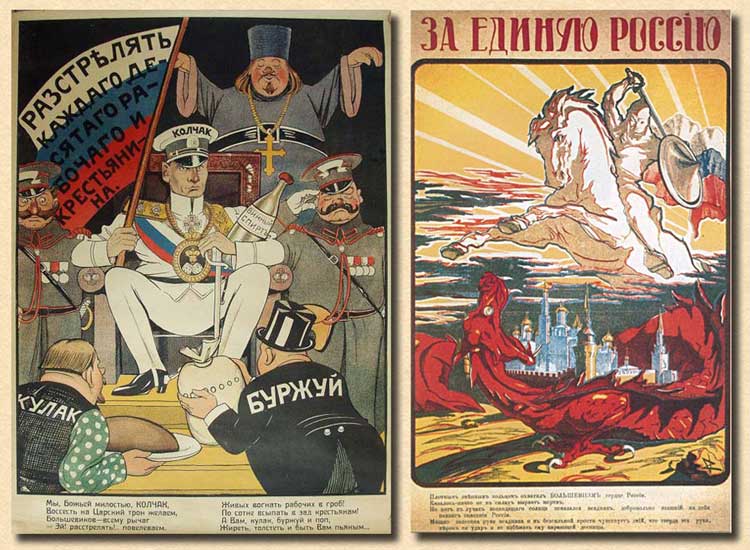
Posters from the Civil War era: an example of the propaganda use of the colours of the white-blue-red flag by opponents and supporters of the White camp.
Home — State Symbols — Flags — Uniforms — Badges & Medals — Money — Other
Pygmy Wars Notes
The original of this page is at kolchakiya.ru/heraldry/Gov_flag.htm.