
State Coats of Arms of Anti-Bolshevik Governments during
the Period of the "Democratic Counterrevolution"
Material prepared by A. Karevskiy.
In March 1917 the Arts Commission of the Provisional Government, chaired by A. M. Peshkov (with A. N. Benua and N. K. Rerikh as co-chairs), took a special interest in clarifying the issue of Russia's state coat of arms and approved the design submitted by artist Ivan Yakovlevich Bilibin. The image depicted a double-headed eagle, stripped of all state attributes and thus returning to its original "Byzantine" prototype. On 21 March 1917 the coat of arms was approved by the Provisional Government and placed on the government seal. The new coat of arms had temporary status until the All-Russian Constituent Assembly could make a final decision on the matter. Until the latter was convened, the seal was to be used "in all cases provided for by law." {1}
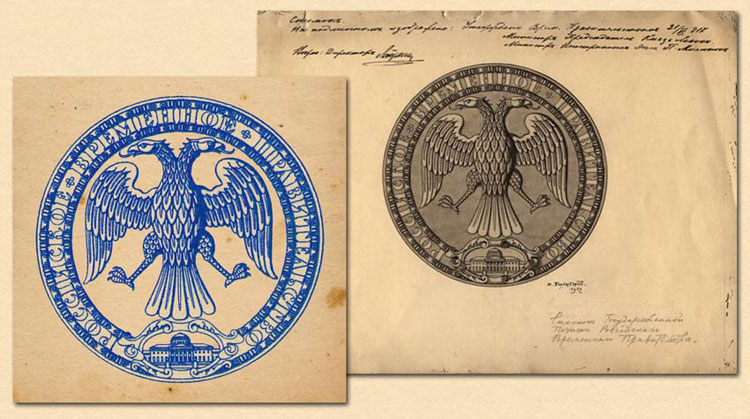
Seal of the Russian Provisional Government, bearing the image of the new state coat of arms
– a double-headed eagle without regalia.
www.heraldicum.ru/russia/rep1917.htm
All-Russian Committee of Members of the Constituent Assembly (KOMUCH)
The question of the coat of arms to be used in the territories controlled by the government, like the question of the state flag, was left unresolved by the All-Russian Committee of Members of the Constituent Assembly. It was assumed that issues of state symbols were entirely within the competence of the All-Russian Constituent Assembly, and that resolving them before the latter resumed its work would be not only premature but also legally unjustified. Until that time, the coat of arms adopted by the Provisional Government – a double-headed eagle without any state regalia – continued to be used in official contexts. In particular, such eagles were present on the seals of state institutions, as well as military units and formations. {2}
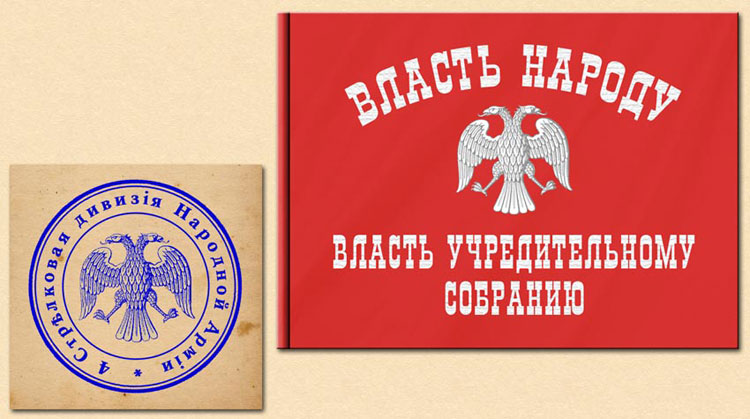
Examples of the use of the coat of arms by KOMUCH: the seal of the HQ of the 4th Rifle (Ufa) Division of the People's Army and one of the first flags ordered by KOMUCH for presentation to units of the People's Army.
www.heraldicum.ru/russia/rep1917.htm [it has been removed in a later version of this page].
Provisional Siberian Government
Unlike KOMUCH, which claimed to be the government of all Russia, the Provisional Siberian Government initially declared itself to be regional in nature, and therefore could show greater independence and creativity in its symbols.
By that time Siberian regional heraldry had already come a long way. The regional coat of arms of the Siberian Kingdom, as we know it today, appeared in 1672 in Tsar Alexei Mikhailovich's titulary book (Titulnik) – the first Russian armorial. It took the form of two upright sables standing holding a five-pointed crown in one hand and a bow with two crossed arrows, points down, in the other. The crown symbolised the Siberian Khanate, which was incorporated into Russia, as well as Siberia's status within the Russian state as the "Kingdom of Siberia". The sables represented Siberia as a land of furs. The bow and arrows, being the main hunting and war weapons of the indigenous peoples, could symbolise their backwardness and savagery. This image became established as the basis of the coat of arms of Siberia.
The final description of the arms of the Siberian Kingdom was enshrined in Emperor Paul I's Manifesto of 16 December 1800 "On the Complete State Coat of Arms of the All-Russian Empire". According to this document, the coat of arms of Siberia had "a shield with a crown... In the coat of arms, there are two black sables standing upright on an ermine field, both holding a golden bow and crossed arrows in their front paws, with the ends pointing downwards, and a golden crown with five pointed teeth in their other paws."
In 1858, during the reform of Russian heraldry carried out under the leadership of B. Kene, Emperor Alexander II approved a new description of the Great State Coat of Arms. The state coats of arms were given crowns: the Siberian was given that of Ivan V, which was made in 1684. It was in this form that it was placed in the third and final version of the Great State Coat of Arms, approved in 1882 by Emperor Alexander III. The arms of the Siberian kingdom had the following description: "on an ermine field, two black sables standing on their hind legs, holding with one of their front legs a golden five-pointed crown and with the other a scarlet bow facing down, on two arrows placed crosswise with their points downwards". {3}
The use of the old symbols in the new, post-revolutionary conditions seemed awkward at first. In the summer of 1917 the Siberian regional movement put forward the idea of developing its own Siberian symbols, unrelated to the previous traditions. On 5 August 1917, at the Conference of Public Organisations of Siberia, the Siberian Flag was approved, as "A combination of two colours: white and green. White symbolises the Siberian snows, and green symbolises the Siberian taiga. The flag is rectangular in shape, divided into two by a diagonal line connecting the upper left corner with the lower right corner, with the upper part being green and the lower part being white." {4}
With the start of organised anti-Bolshevik uprisings in Siberia in the spring and summer of 1918 and the formation of state structures and armed forces, appropriate organisational measures were required. In the early stages of the struggle the question of symbols was carefully avoided. The West Siberian Emissariat, formed on 26 May 1918 in Novonikolaevsk (from 8 June 1918 in Omsk), had temporary authority in the Far East with a mandate from the Provisional Government of Autonomous Siberia. It did not consider itself authorised to decide such issues. An example of this approach is the seal of the Irkutsk Provincial Emissariat, which totally lacked heraldic symbols. {5}
With the transfer of power on 23 June 1918 to the Provisional Siberian Government, the situation changed. On 21 June 1918 an order was issued in Omsk for the Steppe-Siberian Corps, signed by Major-General P. P. Ivanov-Rinov, which included: "The corps commander is ordered to announce that, on the orders of the Commander of the West Siberian Army, the seal should be the size specified in the regulations on correspondence. The coat of arms should depict an eagle without a crown." {6}
After the adoption of the Declaration of State Independence of Siberia on 17 July 1918 (4 July in the old calendar), the question of state symbols became particularly relevant. Work began on the preparation of designs for a new Siberian coat of arms. On 4 August 1918 Major-General A. N. Grishin-Almazov, head of the War Ministry, reported to the Council of Ministers on two options for the coat of arms: the double-headed eagle of the Provisional Government and the historical coat of arms for Siberia.
The grand opening of the 2nd Session of the Siberian Regional Duma, the highest legislative and representative body of autonomous Siberia, took place on 15 August 1918. The meeting hall was decorated with a coat of arms designed by the Tomsk artist Filipp Belikh. The coat of arms echoed the symbols of the Siberian flag. At the same time, the official seal of the Siberian Regional Duma bore a different image: the all-Russian coat of arms of the Provisional Government.). {7}
Meanwhile, based on the results of Grishin-Almazov's report, a new version of the coat of arms was prepared on 16 August 1918, with the sables supporting not a crown but a black double-headed eagle with outstretched wings, which was intended to emphasise that the revival of all Russia would begin in Siberia. The coat of arms was placed on a white mantle with a green lining and gold fringe; the green color symbolized the taiga, and the gold symbolized the gold mining industry. The coat of arms was designed by artist Gleb Alexandrovich Ilyin. {8}
This coat of arms was not officially approved, but it appeared on the banknotes of the Siberian Provisional Government, issued on the basis of the Decree of the Administrative Council of the Provisional Siberian Government of 19 September 1918. At the same time, the 5% short-term obligations of the State Treasury of Siberia issued on the basis of the Resolution of the Administrative Council of the Provisional Siberian Government of 1 October 1918 bore the state coat of arms of the Provisional Government period.
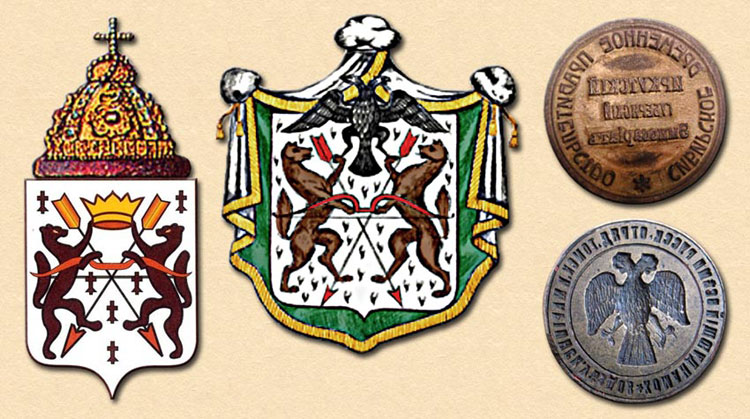
Siberian heraldry.
1 — Coat of arms of the Kingdom of Siberia, which was part of the Great State Coat of Arms of the Russian Empire;
2 — The coat of arms of the Siberian Republic designed by artist G. A. Ilyin, proposed based on the findings of a report by Major-General Grishin-Almazov, head of the Military Department of the Provisional Siberian Government;
3 — the seal of the Irkutsk Provincial Emissariat. Image taken from: forum.kladoiskatel.ru.
4 — Seal of the Commander of All-Russian troops in the Tomsk and Mariinsk districts (presumably from the period under consideration). Image taken from: kladenets.ru.
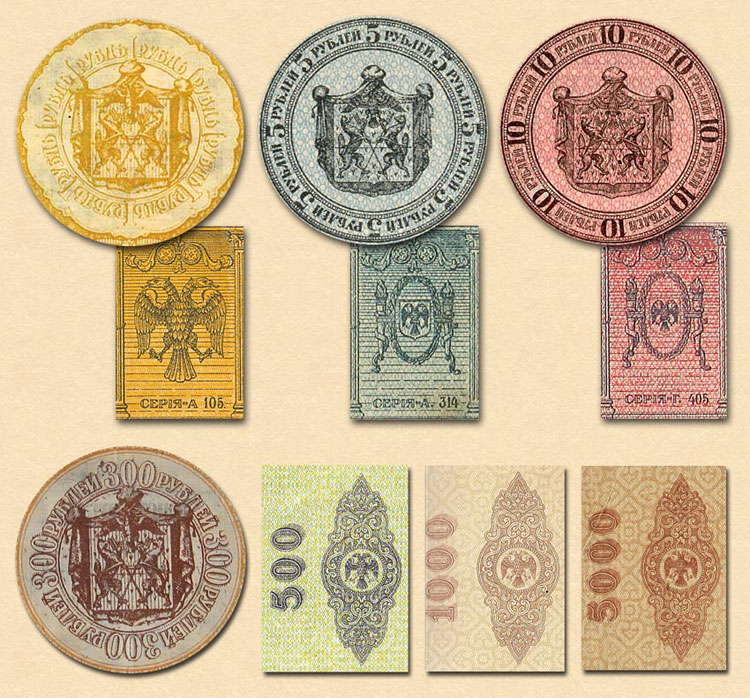
State symbols on the banknotes of the Provisional Siberian Government
Notes:
(1) Soboleva N. A. and Artamonov V. A. in "Symbols of Russia." Moscow, 1993, pp. 194-195.
(2) Examples of such seals can be seen in: RGVA. F.39500. Op.1. D. 10. L .70 (seal of the HQ of the People's Army 4th Rifle Division); RGVA. F.39500. Op.1. D.1. L.313 (seal of the head of the Kazan Water District).
(3) Koshelev A. in "Coat of arms of Siberia // Darovanie No. 2", 1997.
(4) Zhuravev V. V. "State symbols of White Siberia: History of White Siberia // Abstracts of the scientific conference", Kemerovo, 1995, p.12.
(5) An image of the seal is available at: www.forum.kladoiskatel.ru/viewtopic.php?t=5638 [link dead]
(6) RGVA. F.34498. Op.1. D.91. L.1.
(7) Siberian Herald newspaper, Omsk, 1918. No. 2. 17 August at GATO. F.72r Op.1 D.14 L.128 & 170.
GATO F.172 Op.2 D.36 L.20.
Zhuravlev V. V. Op. cit. p. 13.
(8) Durov V. A. in "The History of Siberian Symbolism during the Civil War" // Gerbovod No. 17", 1997 cited at www.heraldicum.ru/russia/civilwar.htm
Home — State Symbols — Flags — Uniforms — Badges & Medals — Money — Other
Pygmy Wars Notes
The original of this page is at kolchakiya.ru/heraldry/Coats of arms of Democratic counterrevolution.htm.